A B2B SaaS marketing director closes Q3 with $800k in new ARR. The Google Ads dashboard claims $480k of it. The HubSpot last-touch report credits paid social ads with half the deals. The content team insists their top-of-funnel blog posts did the real work. Every dashboard tells a different story – because each one is measuring a different slice of the marketing funnel.
That’s exactly the problem full funnel attribution exists to solve: one coherent view of how every marketing touchpoint across your marketing channels – from first ad impression to closed-won deal in the CRM – contributes to revenue across the entire customer journey.
In this guide, we’ll cover what the term actually means, how it maps to the funnel stages most teams already know, how it differs from the partial revenue attribution most SMBs are doing today, and a 5-step plan for connecting marketing efforts to revenue end to end.
Let’s start with what it means.
What is full funnel attribution?
Full funnel attribution is the practice of tracking and assigning credit to every marketing touchpoint a prospect encounters, from first interaction with your brand all the way through closed-won revenue (and, in mature setups, through renewal and expansion). It’s what distinguishes the approach from partial measurement – last-click that only credits the final ad, or top-of-funnel that only tracks lead capture.
A few things worth getting straight up front.
It isn’t a specific attribution model. It’s a scope. It means tracking across the entire funnel. You can apply any model on top of it – first-touch, last-touch, linear attribution, time-decay, position-based, data-driven – across the resulting marketing data. For a side-by-side breakdown of every model, see our guide on attribution models.
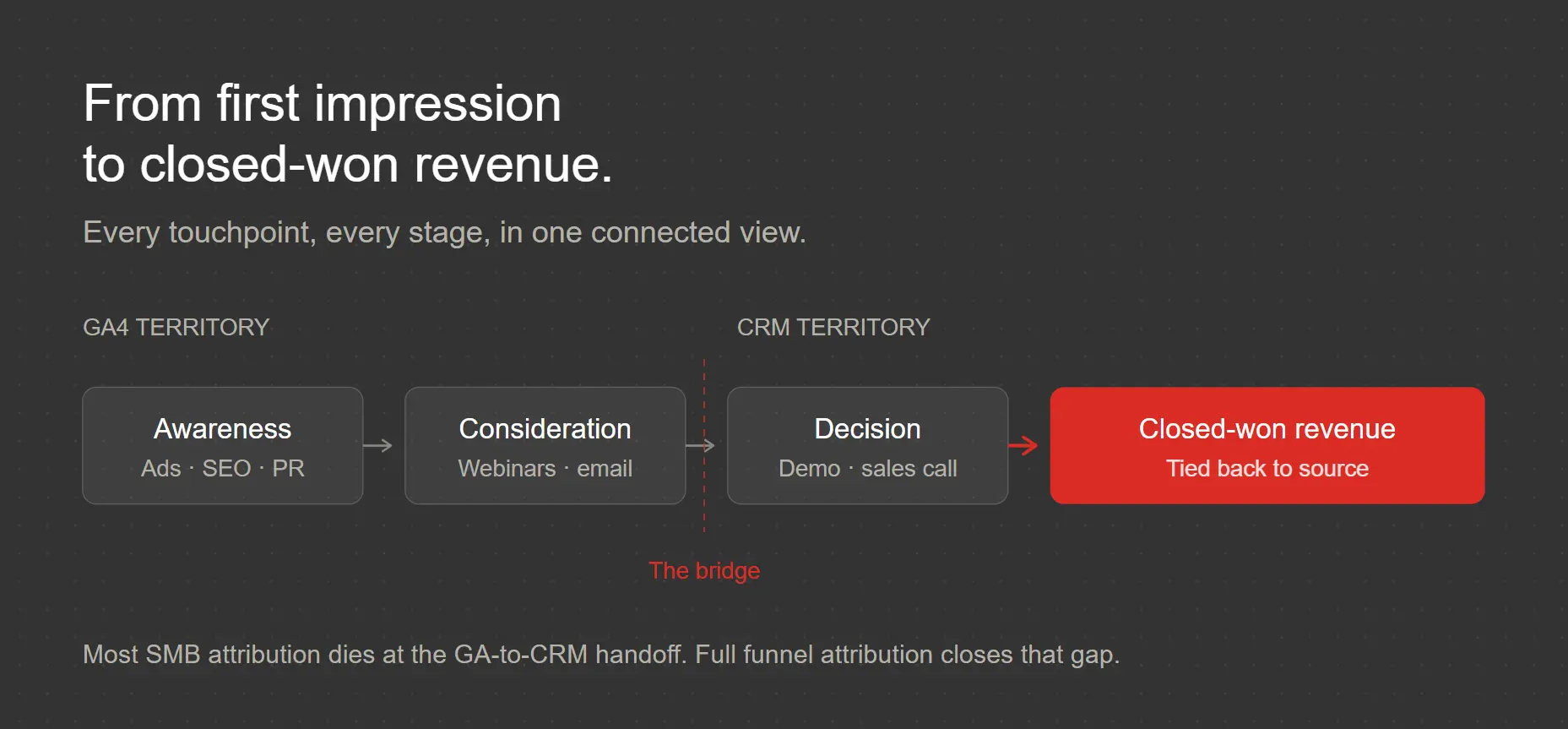
It has to connect online behavior with pipeline behavior. Web visits, ad clicks, email opens on one side; opportunities, stage changes, closed-won on the other. For most B2B SMBs, that means connecting Google Analytics with a CRM. Without that bridge, your marketing data sits on one side and your crm data on the other, with no way to tie the two together. That disconnect is exactly what makes most marketing spend conversations unproductive.
The opposite isn’t “no attribution.” It’s siloed attribution – every channel owner reporting their own numbers, every platform claiming credit for the same deal, nobody with one version of the truth. The full funnel approach reveals the complete customer journey siloed reports miss.
The funnel stages: what to attribute at each
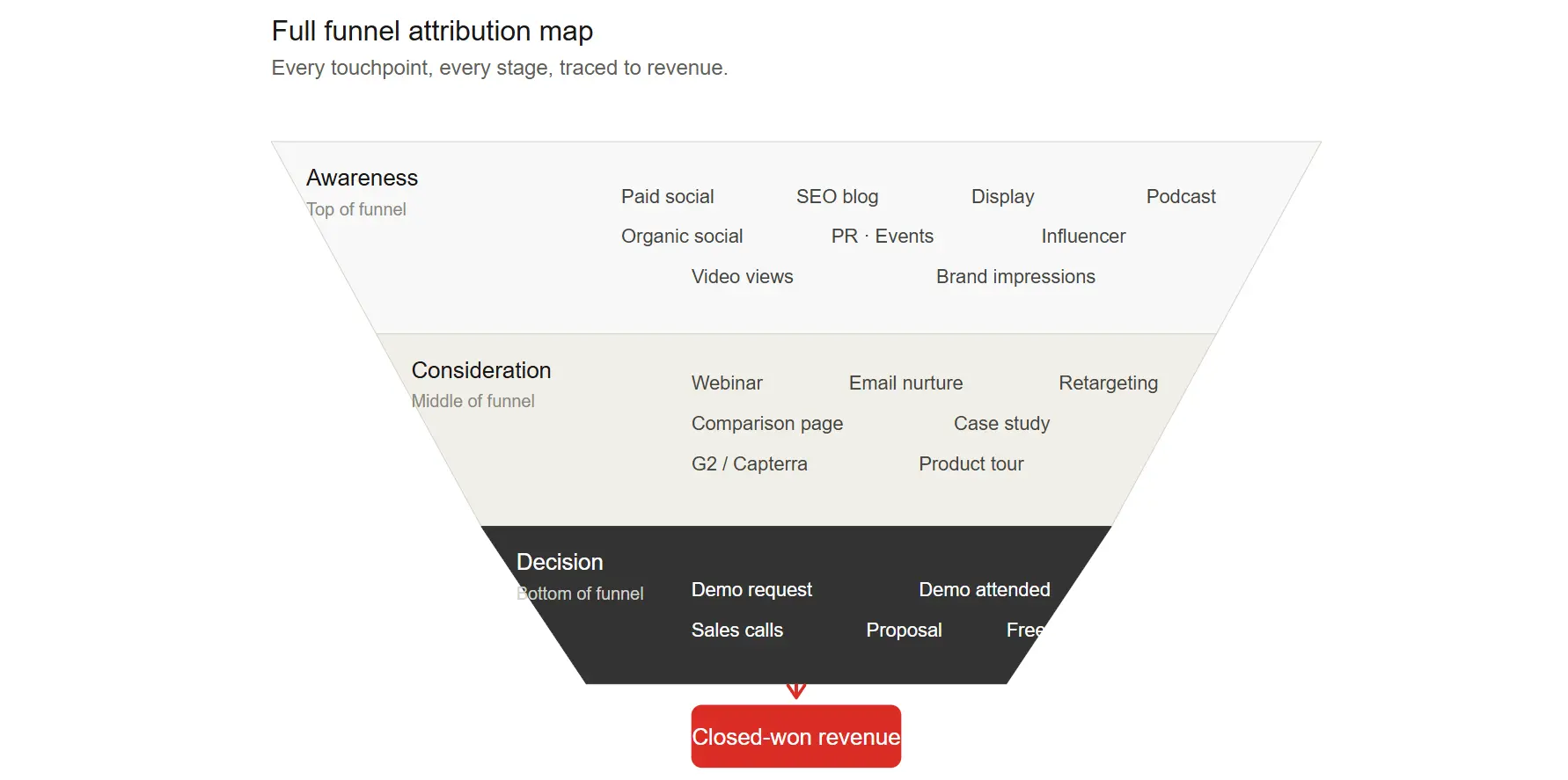
Each marketing funnel stage has different touchpoints, different signals, and a different attribution problem. Walking through them is the easiest way to make full funnel attribution concrete.
Awareness (top of funnel)
What happens: First exposure at the top of the sales funnel. The prospect doesn’t know you exist yet.
Typical touchpoints: Paid social ads, display, podcast sponsorships, SEO blog posts, organic social, influencer mentions, PR, events, video views.
What to attribute: The channel that first introduced the prospect. In GA4, that’s the source/medium on the first session. For anonymous journeys (impressions without clicks), you’re relying on platform data and view-through conversions – imperfect, but directional. A first-touch attribution model fits cleanly here within a full funnel attribution setup that surfaces the rest of the customer journey downstream.
Biggest trap: Over-crediting the top because impressions are cheap. Awareness across different channels doesn’t translate to revenue if those channels don’t nurture through.
Consideration (middle of funnel)
What happens: The prospect is researching. They have a problem and you’re on their shortlist.
Typical touchpoints: Content downloads, webinars, email nurture, retargeting, comparison pages, case studies, product tours, review sites (G2, Capterra).
What to attribute: Every interaction that moves the prospect closer to sales-ready. In CRM terms: contact-level events that feed lead scoring or MQL qualification.
Biggest trap: Middle-of-funnel is where most SMB attribution silently breaks. The user interactions are real, but they’re scattered across a marketing automation tool, a webinar platform, an email tool, and your analytics – and none of them tie back to the CRM. Data silos turn a complete picture of marketing activities and user interactions into fragments.
Decision (bottom of funnel)
What happens: Evaluation. Demo booked, proposal sent, procurement involved. Buyers here have higher buying intent.
Typical touchpoints: Demo request, demo attended, sales calls, proposal viewed, free trial, contract sent, closed-won.
What to attribute: Pipeline stage transitions and closed-won revenue. This is where attribution becomes revenue attribution – actual dollars flow back to the channels that drove them.
Biggest trap: This is where the GA-to-CRM gap kills SMB attribution. Without a bridge, conversion data and lead data sit in one place; channel data sits in another. Two halves, never meeting.
Post-sale (retention and expansion)
What happens: Closed-won isn’t the end – especially for SaaS. Retention, customer content, and upsell continue to drive revenue generation.
Typical touchpoints: Onboarding emails, customer webinars, product education, community forums, renewal reminders.
What to attribute: Revenue from renewals, expansion, and cross-sell – traced to the touchpoints that influenced existing customers.
Biggest trap: Most SMBs skip this. That’s fine. Get pre-sale working first.
Full funnel vs. single-touch attribution
Single-touch – first-click only or last-click only – was good enough when sales cycles were short.
Here’s how the approaches stack up:
| Approach | What it measures | Best for | Biggest blind spot |
| Last-click only | Final source before conversion | High-intent search ads at the bottom of the funnel | Ignores what built awareness – over-credits paid ads |
| First-click only | Original source | Brand-awareness measurement | Ignores nurture and decision-stage touchpoints |
| Single-channel approach | Touchpoints in one platform | Validating one channel | Misses cross-channel influence |
| True end-to-end (all channels + CRM) | Every touchpoint mapped to revenue | Multi-channel B2B with multi-week sales cycles | Requires connecting analytics and the CRM |
For B2B SMBs running 3+ different channels with sales cycles longer than a week, single-touch lies in predictable ways. It systematically over-credits the bottom of the funnel and under-credits whatever built demand in the first place. The full funnel approach is the right scope. The real question is how to implement it without enterprise infrastructure.
Why this is hard for SMBs
Here are the reasons SMB attribution fails. Skip these and you’ll build on broken foundations.
Inconsistent UTM tagging. Marketing campaigns get launched by different people with different conventions. “facebook” vs. “Facebook” vs. “fb” shows up as three separate marketing channels. The reports look fine; the underlying data is garbage, and your channel performance shifts week to week for no reason at all.
Data silos across platforms. Google Ads has one view, Meta has another, LinkedIn has a third. Each platform claims every conversion it touched. Add up the numbers and you get 400% attribution — every deal credited four times. Data silos like these break the full funnel approach. Because each platform reports from its own multiple sources of self-attributed data, no single dashboard gives you the full picture of marketing spend versus revenue.
The analytics-to-CRM gap. The single biggest breakpoint. GA4 knows how website visitors got to the site. Your CRM knows which leads turned into revenue. By default, these crm systems and analytics tools simply don’t talk to each other. Without a bridge, you have top-of-funnel only – connecting marketing efforts and customer interactions to revenue is impossible, and you can’t reliably attribute conversions back to the campaigns that actually drove them.
Privacy shifts and limited visibility. Even with Google’s reversal on third party cookies in Chrome and the retirement of the Privacy Sandbox, the era of third party cookies as reliable measurement is over. Safari and Firefox have blocked third party cookies for years; ad blockers chip away at the rest. Third party tracking is unreliable, and third party data sourced from cookies is patchy at best. Stop relying on third party cookies and build on first party data instead – your CRM is the best first party data source you have. Setups that prioritize first party data degrade much more gracefully than tracking that leans on third party cookies. Add a “how did you hear about us?” form field to capture self-reported attribution while you’re at it.
Most of these are fixable in weeks. Here’s how.
How to implement full funnel attribution in 5 steps
Full funnel attribution doesn’t require an enterprise platform or a data team. It’s about getting your existing marketing activities and systems talking to each other. Five steps.
Step 1 – Map your funnel and define your conversion events
List the stages your business actually uses. For most B2B SMBs: Visitor → Lead → MQL → SQL → Opportunity → Closed-won. Define the events that mark each transition. Configure them as conversion events in GA4 and pipeline stages in your CRM.
This is also where sales and marketing teams have to align on definitions. If marketing teams call something an MQL and sales teams call it unqualified, you’ll waste months arguing about reports. Sales and marketing teams that align on stage definitions before instrumenting save months later.
Done looks like: A doc listing each stage, the event marking entry, and where it’s tracked.
Step 2 – Standardize UTMs across every channel
Pick a UTM convention and enforce it. Every paid campaign, email link, social post, and partner link uses the same source/medium/campaign structure. Build a shared template (a Google Sheet works fine). Lowercase only. No spaces. Consistent separators. Our UTM parameters guide has a working template you can copy.
Audit new UTMs hitting analytics monthly. Five minutes of cleanup beats five hours of reconciliation later, and it’s the cheapest way to get reliable campaign performance data.
Done looks like: A documented UTM convention, shared URL builder, monthly audit.
Step 3 – Connect Google Analytics and your CRM
This is the step that actually closes the gap. Every visitor’s source/medium/campaign data should flow into the CRM and attach to the lead at lead capture. When that lead progresses to closed-won, the revenue should flow back into analytics, attributable to the original source. That’s full funnel visibility – every step from impression to revenue, every customer interaction along the way, in one connected view.
This is the GA-to-CRM bridge. And it’s where most SMB attribution projects stall. You can build it in-house or use a tool designed for it.
For SMBs on Salesforce, HubSpot, Pipedrive or Zoho, GA Connector handles this out of the box. It captures first-click, last-click, and every touchpoint in between, pushes the click path data into the CRM lead record, and syncs closed-won revenue back. Teams go from disconnected to end-to-end full funnel attribution tracking in days. Larger enterprises with custom stacks build their own or use platforms like Bizible. For SMBs, build-vs-buy favors buy. (Salesforce teams: see the easiest way to implement marketing attribution in Salesforce walkthrough.)
Done looks like: Every CRM lead has first-click source, last-click source, campaign, medium, keyword, and landing page filled in. Closed-won revenue shows up in attribution reports.
See full funnel attribution inside your CRM — Start a free trial of GA Connector →
Step 4 – Choose your attribution model(s)
Full funnel data is the scope. The attribution model is how you distribute credit across it. For most SMBs with multi-week sales cycles, position-based or time-decay is reasonable. Linear attribution works as a sanity check. Teams with higher conversion volume can graduate to data-driven attribution (GA4 has a built-in data-driven model, though it requires 300+ conversions and 3,000+ path interactions in 30 days).
Run two models in parallel. When they disagree sharply, investigate before changing budget.
Done looks like: A documented decision on your primary model and which one you run alongside.
Step 5 – Build the reports that will actually get used
The data only creates value when it drives data driven decisions. Build three core full funnel attribution reports:
- Channel revenue report – closed-won revenue by source/medium across a rolling 90-day window. Use this to assign credit to channels and reallocate the marketing budget.
- Pipeline influence report – which marketing channels show up in the touchpoint history of closed-won vs. closed-lost.
- Cost-per-pipeline report – spend by channel divided by pipeline. The report your CFO actually cares about for budget allocation. (See our ads ROI calculation guide for the underlying math.)
Build them in Looker Studio or your CRM’s reporting. The goal is a weekly meeting where marketing teams and sales teams look at the same numbers and agree on next steps. That’s what turns attribution data into actionable insights about marketing effectiveness.
Done looks like: Three saved reports, weekly cadence, reviewed by marketing and sales.
Common full funnel attribution pitfalls
Six traps that catch teams even after implementation.
Partial implementations that look complete. Analytics is set up. The CRM is set up. They’re not connected. The most common failure mode of all – a “full funnel attribution model” that’s actually two disconnected halves. The full funnel model only works when both ends are wired together.
Defaulting to last-touch out of habit. Even with end-to-end data, teams revert to last-click. Force yourself to look at multiple models.
Ignoring dark social and self-reported sources. Add “how did you hear about us?” to the demo form. It catches attribution your tracking won’t – peer recommendations, podcast mentions, Slack shares, and other offline channels. Imperfect data beats no data, especially as third party cookies decline.
Reporting on MQLs instead of revenue. MQL volume is a vanity metric if MQLs don’t convert. Tie attribution to revenue or pipeline. Marketing impact is measured in dollars, not in form fills.
Account-level vs. contact-level confusion. In B2B, multiple people from one company often touch your marketing during the buying process. Account-level matters more for enterprise; for most SMBs, contact-level is the pragmatic starting point.
Treating attribution as set-and-forget. Channel mix changes. Campaigns launch. UTMs break. Audit quarterly or it will degrade.
Tools for full funnel attribution
Three tiers, by company size.
Free / already-paid (GA4 + CRM native reporting). Enough for single-channel, short-cycle businesses. Falls apart the moment you need to connect channel data to CRM revenue across online and offline touchpoints.
Integration-focused tools for SMBs (GA Connector and similar). They connect analytics to the CRM. Priced for SMB marketing budget realities. Fast to implement. The fit for 11–200-employee companies on a major CRM. Closes the bridge that single-tier setups can’t, making accurate attribution actually achievable. This is what enables marketers at SMBs to run full funnel attribution at all.
Enterprise attribution platforms (Bizible, Marketo Measure, etc.). Powerful, expensive, slow. Right for organizations with custom stacks and dedicated data teams. Overkill for most SMBs — marketing roi rarely justifies the price below 500 employees.
The best tool is the one that closes the specific gap in your stack. For most SMBs, that’s GA-to-CRM. For an ecommerce store with one paid channel driving immediate sales, it might be something else entirely.
A systems problem, not a tools problem
Full funnel attribution isn’t actually out of reach for SMBs – it’s just been marketed that way by enterprise vendors. The five steps above are about getting your existing systems (analytics, CRM, ad platforms) talking to each other. The bottleneck isn’t strategy; it’s the missing bridge between website data and the CRM.
Close that bridge, standardize tagging, pick a model, build three reports. Marketing performance gains compound from there – better budget allocation, sharper marketing strategies, fewer arguments about which marketing campaigns drove what. Full funnel attribution brings clarity to a sales funnel with too many invisible parts.
If you’re on Salesforce, HubSpot, Pipedrive, or Zoho, GA Connector is the fastest way to close the GA-CRM gap.
Start your free trial of GA Connector → | Book a demo →
FAQs
What is full funnel attribution in simple terms?
It tracks every marketing touchpoint across the entire customer journey – first ad impression to closed-won – and assigns credit to each. Most attribution stops at form fill. Full funnel attribution follows the lead through the CRM all the way to revenue, surfacing valuable insights into which channels actually generate income.
What’s the difference between full funnel attribution and multi touch attribution?
Multi touch attribution is the credit-distribution method (linear attribution, position-based, time-decay, data-driven). Full funnel attribution is the scope – tracking the customer journey end to end. You apply a multi-touch model on top of full funnel data.
What’s the difference between revenue attribution and marketing attribution?
Marketing attribution covers any signal – clicks, form fills, MQLs, opportunities, revenue. Revenue attribution narrows that down to closed-won. The full funnel approach is essentially attribution that includes revenue at the bottom.
How do I attribute revenue to marketing when deals close offline in a CRM?
Connect analytics to the CRM so the channel data captured at lead creation persists through to closed-won. Then sync closed-won revenue back. Tools like GA Connector do this for major CRMs.
Does GA4 support full funnel attribution on its own?
Not for B2B. GA4 handles the website portion well but doesn’t know anything about CRM events – opportunities, stage changes, closed-won. Without that, your visibility stops at the form fill.
What’s the best attribution model for B2B?
For most SMBs running full funnel attribution with multi-week sales cycles, position-based (40/20/40) or time-decay is a reasonable place to start.
How do I handle touchpoints I can’t track (word of mouth, dark social)?
Two pragmatic moves. First, add a “how did you hear about us?” field on demo forms —]- self-reported data catches what tracking misses. Second, accept that some attribution is permanently invisible. With third party cookies fading and offline campaigns common in B2B, expecting 100% coverage isn’t realistic. Aim for 80% across online and offline channels.
How long does this take to implement for an SMB?
For an SMB on a major CRM with analytics already in place, days to weeks for a tool-based implementation. Months if you build it custom. The gating factor isn’t tooling – it’s getting the team aligned on stage definitions and UTMs.