Marketing attribution software connects ad spend to the revenue your CRM already knows about. It captures where each lead came from, then reports which campaigns produced closed deals rather than form fills. The right tool depends almost entirely on how long your sales cycle runs.
Attribution software exists because analytics stops at the form fill
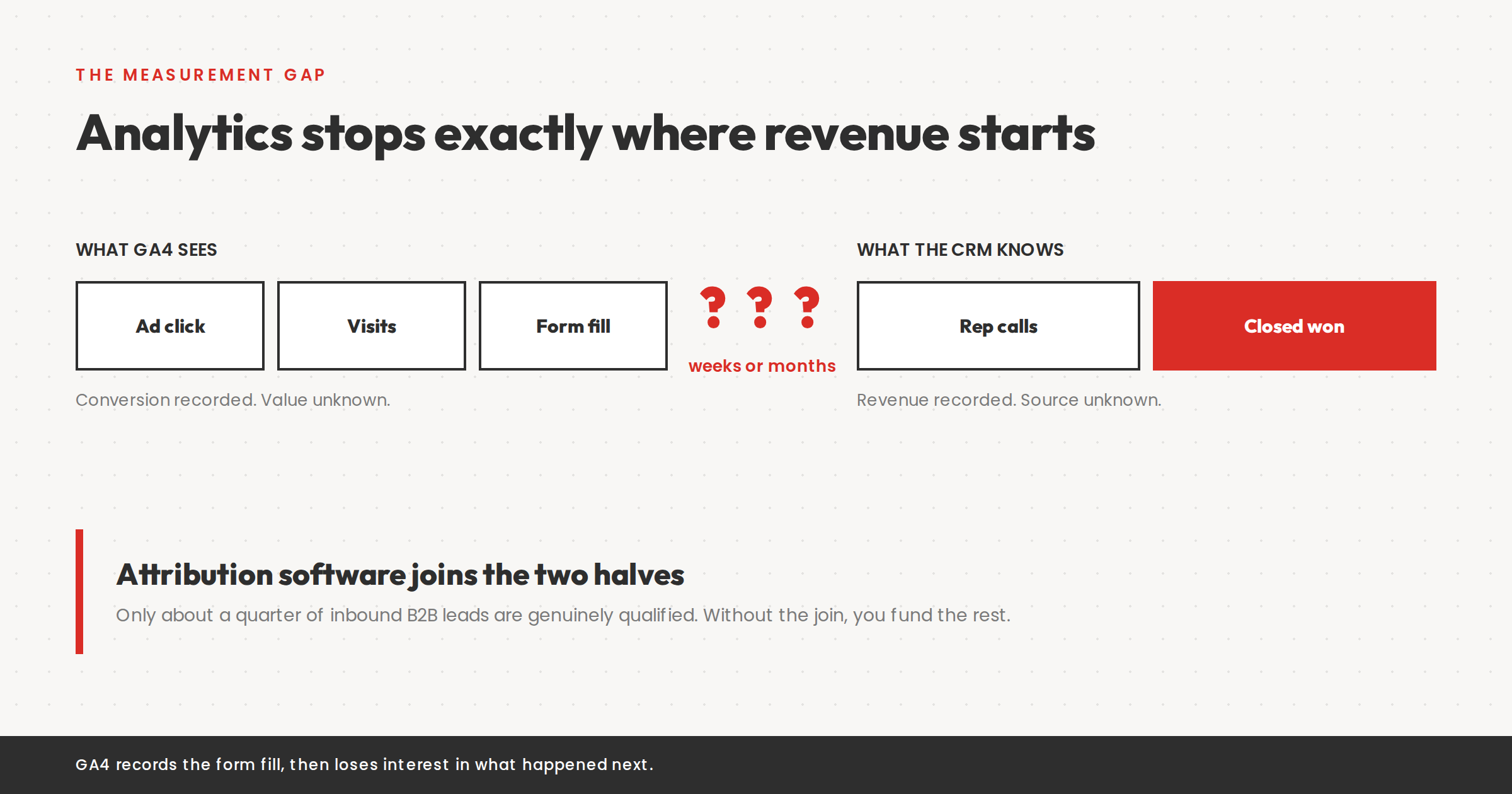
Google Analytics measures what happens on your website. Most B2B sales happen somewhere else, closed by a rep over weeks or months. Attribution software bridges that gap by joining web session data to CRM outcome data. Without it, you optimize toward form submissions and hope revenue follows.
The gap is structural, not a setting you forgot to switch on. GA4 records a form submission as a conversion and then loses interest. Whether that submission became a $2,000 deal or a support ticket is invisible to it.
The lead quality problem underneath is well documented. Research from MarketingSherpa found most B2B organizations route every inbound lead to sales. Only about a quarter are genuinely qualified. Optimize toward form fills and you’re funding the other three quarters.
The category splits by how long your sales cycle runs
This is the division that matters, and almost no roundup makes it. Ecommerce attribution tools assume the purchase happens in the same session as the click. They’re built around ad platform APIs, pixel data, and same-day return on ad spend.
B2B tools assume the opposite. The conversion is a form fill, the revenue shows up months later, and the connecting tissue is a CRM record.
Committee buying is why. Gartner puts the typical B2B buying group at six to ten decision makers, each doing their own research. Gartner also finds buyers spend only around 17% of their purchase time meeting suppliers at all. The rest happens somewhere you can’t see.
Multi-touch attribution and marketing mix modeling answer different questions
Multi-touch attribution follows individual people across touchpoints. It tells you a specific lead saw a LinkedIn ad, searched your brand, then converted. It needs identity resolution to work at all.
Marketing mix modeling ignores individuals entirely. It estimates channel contribution statistically from aggregate spend and outcomes, and it wants years of history plus real variation in what you spent.
Large advertisers run both and triangulate. Most companies reading this need multi-touch first, because they still can’t answer a much simpler question about which campaigns produce customers.
Six tools built for B2B and long sales cycles
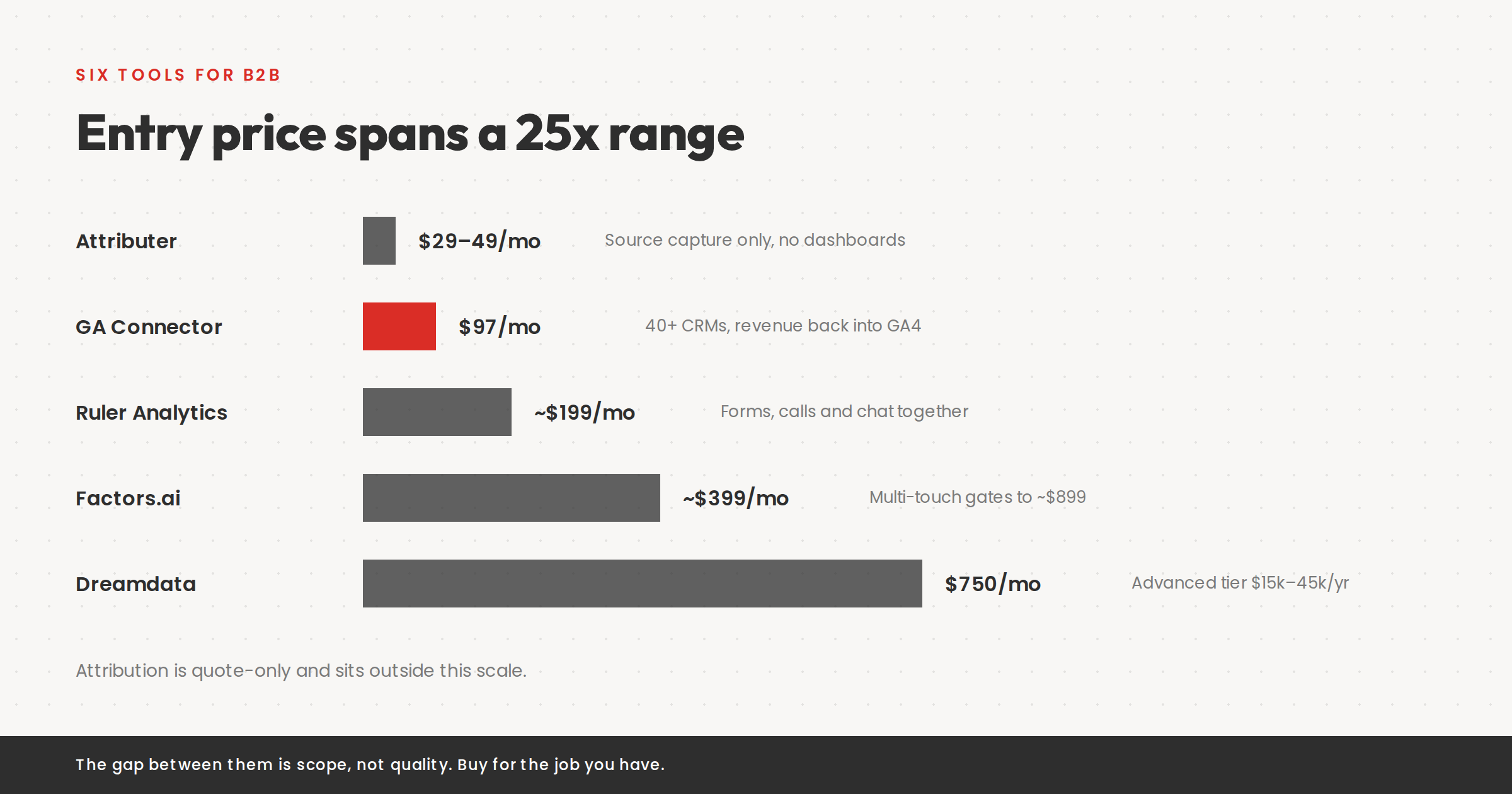
These tools assume revenue arrives late and lives in a CRM. That one assumption shapes how they capture data, where they store it, and what they can report on. They run from $29 a month to tens of thousands a year, and the difference is mostly scope rather than quality.
GA Connector fills CRM records with traffic source data and sends revenue back to GA4
GA Connector captures first-click source, last-click source, the full multi-touch path, campaign, ad group, keyword, landing page, and device. All of it gets written onto the CRM lead or contact record at creation. Deal and revenue data then flows back into GA4 keyed on the GA Client ID.
That Client ID linkage matters more than it sounds. CRM outcomes land in GA4 as events tied to a client, so you can analyze revenue under any GA4 attribution model. That includes the data-driven model Google Ads Help now treats as the default. You’re not stuck with last click.
It connects more than 40 CRMs to Google Analytics, deepest on Salesforce, HubSpot, Pipedrive, and Zoho. Pricing starts at $97 a month based on page views, billed per CRM account rather than per seat. The CRM to GA4 flow is a $197 add-on. Thirty-day trial, no card.
Because the attribution data lives permanently on the CRM record, cookie expiry and ad platform windows stop mattering. Cycles beyond 12 months work without anything special.
The tradeoff is scope. It solves attribution rather than trying to be a full analytics platform, and organic keyword data isn’t available because Google encrypts it.
Dreamdata models account-level journeys for B2B SaaS
Dreamdata stitches individual contacts into accounts and models the whole buying committee journey. It suits organizations with a real revenue operations function, because someone has to use all that flexibility.
Pricing has drifted steadily away from transparency. Capterra lists a genuinely useful free tier covering B2B web analytics and company identification. Above that sits Activation Starter at $750 a month. The Attribution Advanced tier is quote-only, and third-party procurement data puts real contracts somewhere between $15,000 and $45,000 a year.
The company raised a $55 million Series B in October 2025. Growth rounds tend to precede pricing changes, so negotiate renewal caps if you’re signing multi-year.
Factors.ai combines attribution with account identification
Factors.ai does multi-touch attribution alongside deanonymizing website visitors at the account level. Teams running account-based marketing usually want both jobs done anyway.
Pricing restructured during 2026. There’s a free tier and an entry plan around $399 a month, but multi-touch attribution gates to the Growth tier at roughly $899 and up. Several tiers went quote-only in the restructure, so published figures may not survive contact with a salesperson.
The account identification side overlaps with Clearbit, 6sense and Demandbase. Worth checking you’re not paying twice for the same capability.
Ruler Analytics connects marketing touchpoints to CRM opportunities
Ruler tracks visitor sessions, matches them to leads on conversion, then syncs closed revenue back into analytics and ad platforms. It covers forms, phone calls and live chat together, which is why service businesses and agencies gravitate to it.
Entry pricing sits around $199 a month, well below the enterprise B2B platforms. It’s a bootstrapped company of roughly fifteen to twenty people in Liverpool, and that cuts both ways. Small teams ship fast and actually answer support tickets. They also carry more concentration risk than a funded competitor.
Ruler ranks near the top of search results for this category with its own roundup of competing tools. Read their comparison pages the way you should read this one.
Attribution handles multi-touch reporting with a paid-performance focus
Attribution, at attributionapp.com, does user-level and account-level multi-touch attribution with strong ad platform integrations and cost autotagging. It pulls conversions from Segment, Stripe, Salesforce, HubSpot and Marketo.
It’s a small bootstrapped shop, around eight people, named a preferred partner by Twilio Segment. If your stack already runs through Segment that’s a genuine advantage.
Good fit for meaningful paid spend and a moderate sales cycle. Very long enterprise cycles stretch past what it was designed for.
Attributer captures lead source into CRM fields at the cheapest end of the category
Attributer writes source data into hidden form fields as a lead submits, so it lands in the CRM with no analytics engineering involved. Plans start around $29 to $49 a month depending on sites and lead volume, with a free tier for very low volumes.
It’s deliberately narrow. No dashboards, no multi-touch modeling past first and last touch, no syncing closed revenue back to Google or Meta. Reporting happens in your CRM or wherever else you send the data.
That narrowness is the point. If you want every lead tagged with a channel and nothing more, this is the cheapest honest answer in the category, and plenty of companies genuinely need nothing more. We’ve written a longer side-by-side of GA Connector and Attributer if you’re weighing the two.
Three enterprise platforms for large or complex stacks
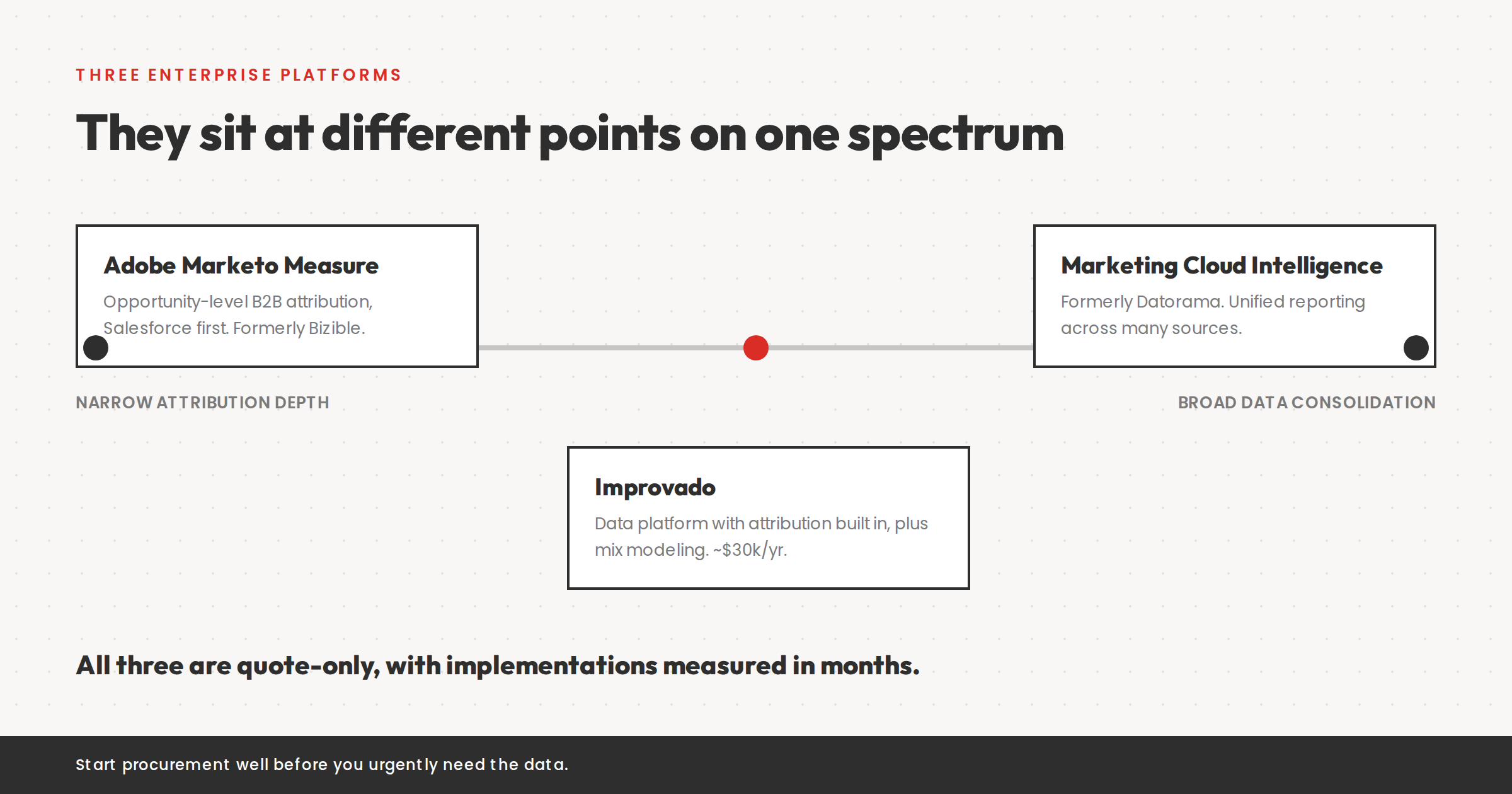
These aren’t point solutions. They assume a dedicated team, real budget, and an implementation measured in months rather than afternoons. Expect quote-only pricing, professional services, and a procurement cycle long enough that you should start well before you urgently need the data.
Adobe Marketo Measure is the former Bizible, still actively developed
Marketo Measure does B2B attribution with deep Salesforce and Marketo integration, handling buying committees and opportunity-level attribution. It’s still under active development. Recent Adobe release notes cover a new attributed opportunity dashboard and reduced Salesforce API consumption.
Cost and complexity are enterprise grade, and implementation usually involves professional services. The rebrand from Bizible also means years of useful documentation sit under the old name, so search both.
Plenty of teams buy this, use a fraction of it, and could have solved the same problem for a tenth of the price. That’s a complaint about how it gets sold, not about the software.
Salesforce Marketing Cloud Intelligence unifies reporting across a large stack
Formerly Datorama, this is a marketing data platform more than an attribution tool. It ingests spend and performance data from many sources into unified dashboards.
Watch the direction of travel. Salesforce launched a newer Data 360-based Marketing Intelligence offering in 2025, so ask directly which product a quote covers and what the roadmap looks like for the one you’re actually buying.
If your pain is data living in fifteen places, this fits. If your pain is that GA doesn’t know which leads closed, it’s heavy machinery for a narrow job.
Improvado consolidates marketing data and runs attribution on top of it
Improvado is an enterprise marketing data platform with attribution built in rather than bolted on. It connects to a very large integration library and handles transformation and governance. The attribution side supports first-touch, last-touch, linear, time-decay and custom models, plus marketing mix modeling.
Pricing is tiered by data volume rather than seats, with reported minimums around $30,000 a year. A dedicated customer success manager and professional services come included, which matters because implementations run weeks rather than days.
It fits organizations where attribution is one job inside a wider data problem. If your only issue is connecting CRM outcomes to campaigns, this is far more platform than you need.
Three tools built for ecommerce and DTC
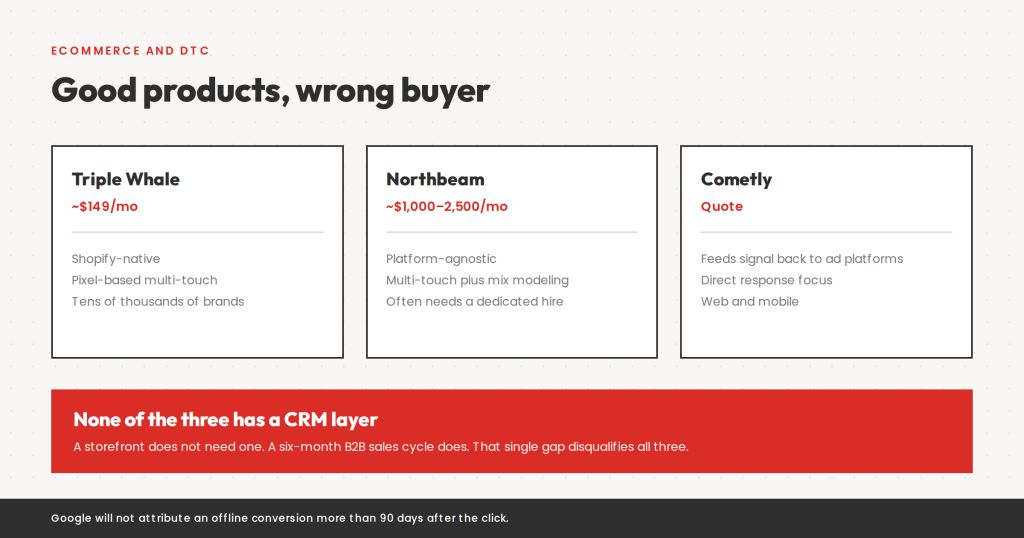
These come up constantly in attribution searches and get recommended to B2B teams who then can’t make them work. They’re good products aimed at a different buyer. The giveaway is that none of them has a meaningful CRM concept, because a storefront doesn’t need one.
Triple Whale reports blended performance for Shopify brands
Triple Whale is Shopify-native, using pixel-based multi-touch attribution inside a wider ecommerce analytics platform. Published plans start around $149 a month, with a higher tier near $219 and enterprise pricing above that.
It now claims tens of thousands of brands and has expanded into media mix modeling, connected TV attribution and AI agents.
For a B2B company with a six-month cycle, the missing CRM layer isn’t inconvenient. It’s disqualifying.
Northbeam models incrementality for high-spend ecommerce
Northbeam pairs multi-touch attribution with marketing mix modeling, and it’s platform-agnostic rather than Shopify-first. Pricing is usage-based and quote-driven, with independent comparisons citing roughly $1,000 to $2,500 a month depending on volume.
It holds up better than pixel-based tools when user-level tracking breaks, which is why high-spend brands run it. It also demands more technical resource, to the point that brands often hire someone specifically to manage it.
Cometly focuses on ad platform conversion feedback
Cometly tracks conversions and feeds enriched data back to ad platforms so their algorithms optimize on better signal. It aims at performance marketers running direct response across web and mobile.
That feedback loop is the whole value, and it assumes conversions happen fast enough for ad platforms to learn from them. Google Ads Help won’t attribute an offline conversion more than 90 days after the click. Long B2B cycles run straight into that wall.
The twelve compared side by side
Entry pricing below reflects published or reliably reported figures as of September 2026. Quote-only tools are marked as such. Treat every number as a starting point, because attribution pricing scales on page views, tracked accounts, data volume or ad spend depending on the vendor.
| Tool | Built for | Entry pricing | Long cycles | Status |
| GA Connector | B2B CRM attribution, 40+ CRMs | $97/mo | Yes, 12 months plus | Active |
| Dreamdata | B2B SaaS account journeys | Free, then $750/mo | Yes | Active |
| Factors.ai | Attribution plus account ID | Free, then ~$399/mo | Yes | Active, repriced 2026 |
| Ruler Analytics | Form, call and chat attribution | ~$199/mo | Yes | Active |
| Attribution | Paid performance, Segment stacks | Quote | Partially | Active, small team |
| Attributer | Simple lead source capture | $29–49/mo | Yes | Active |
| Adobe Marketo Measure | Enterprise B2B, Salesforce first | Enterprise quote | Yes | Active |
| Marketing Cloud Intelligence | Unified marketing reporting | Enterprise quote | Yes | Active, roadmap shifting |
| Improvado | Enterprise marketing data plus attribution | ~$30k/yr | Yes | Active |
| Triple Whale | Shopify DTC | ~$149/mo | No | Active |
| Northbeam | High-spend ecommerce | ~$1,000/mo | No | Active |
| Cometly | Ad platform feedback | Quote | No | Active |
Choosing comes down to three questions
Most shortlists collapse once you answer these honestly. Vendor comparison pages rarely ask them, because the answers eliminate most of the market including the vendor asking. Work through all three before you book a demo, not after a salesperson has framed the problem for you.
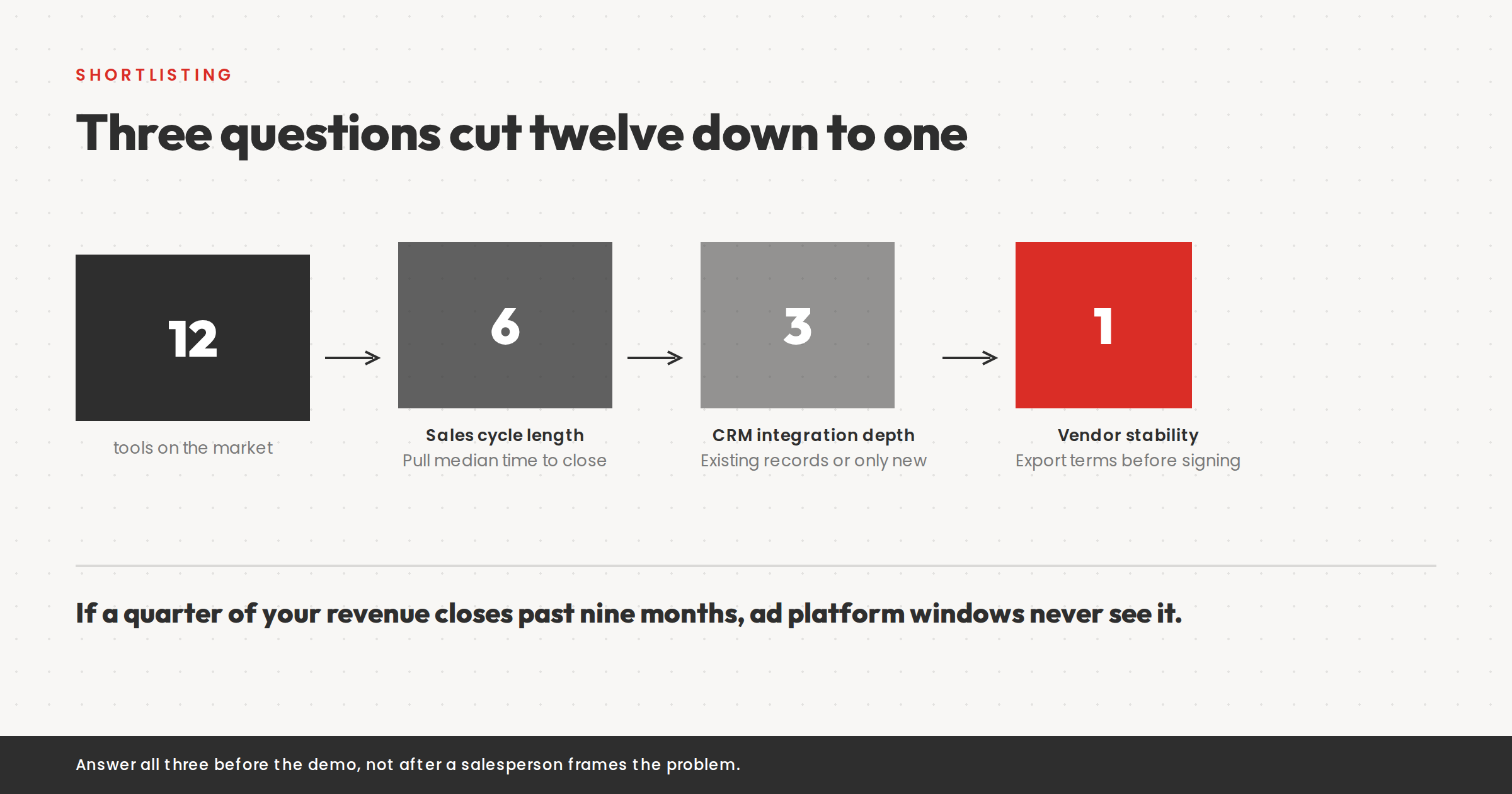
Your sales cycle length eliminates most of the list
If deals close in a single session, the ecommerce tools are right and the B2B tools are overbuilt. If deals take four months, the reverse holds and no amount of configuration fixes it.
Median time to close is the most useful number in this whole decision. Pull it from your CRM before you take a demo.
Watch the tail as well as the median. If a quarter of your revenue closes past nine months, ad platform attribution windows will never see that quarter.
Your CRM decides what is even possible
Attribution data has to land somewhere your team already reads. A tool that doesn’t integrate properly with your CRM produces a parallel dashboard nobody opens after month two.
Check integration depth rather than logo presence on a page. Ask specifically whether the tool writes to existing records or only new ones, because that difference bites hard during migrations.
Ask about field limits too. Most CRMs cap custom text fields at 255 characters, which quietly truncates long multi-touch path data.
Vendor stability is now part of the evaluation
Attribution is a small, consolidating category. Tools get acquired into larger portfolios, repositioned toward whichever segment is funding growth, or retired for reasons that have nothing to do with how well they work.
Ask who owns the company, when it last raised, and whether the product you’re buying is the one the company is betting on. A capable tool inside a big suite can still get deprioritized.
Ask about data export terms before you sign, not when you need them. Attribution history is expensive to rebuild and impossible to recover once it’s gone.
Attribution rollouts fail for reasons unrelated to the tool
The software is rarely the problem. Implementations fail on data hygiene, on process, and on expectations nobody set out loud. Fixing those three things before you buy will do more for your reporting than any feature on a comparison grid.
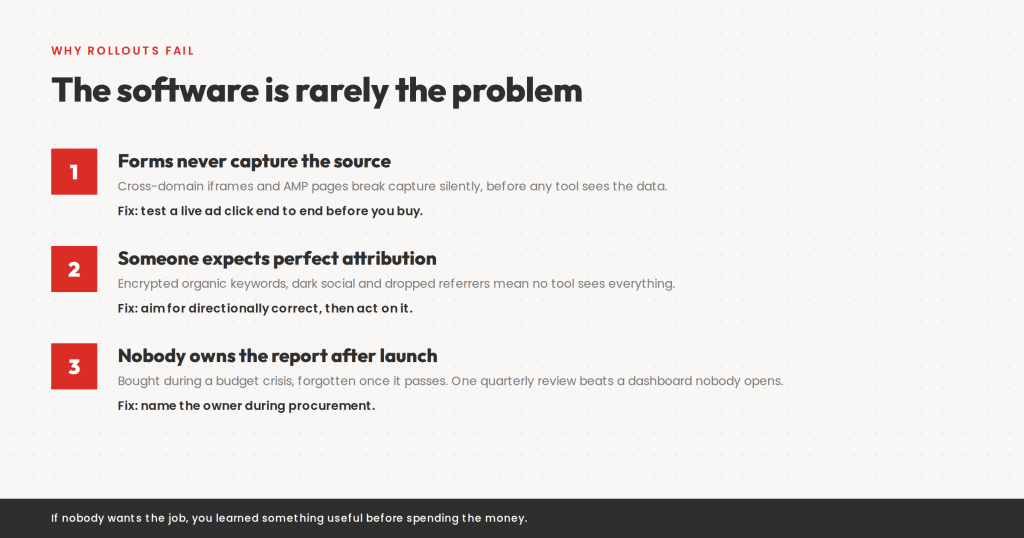
Forms that do not capture source data break everything downstream
Every tool here depends on capturing traffic source at the moment someone converts. If your forms sit inside cross-domain iframes, or live on AMP pages that block custom JavaScript, capture breaks silently.
Audit your forms before you buy anything. Our guide to capturing UTM parameters in contact forms covers the common breakages. Submit a test conversion from a live ad click and confirm the source data actually arrives in the CRM record.
This is the most common cause of attribution data that looks wrong and gets quietly abandoned six weeks later.
Expecting perfect attribution guarantees disappointment
No tool sees everything. Google encrypts organic keyword data. Dark social, word of mouth and forwarded links leave no trace. Referrer data drops when visitors move from an HTTPS site to an HTTP page.
Directionally correct beats precisely wrong. The goal is knowing which campaigns to cut and which to fund, not building a perfect ledger of every touch.
Teams that demand certainty before acting usually keep spending on the campaigns they already doubted.
Nobody owns the report after launch
Attribution tools get bought during a budget crisis and forgotten once it passes. The teams that get value run a regular review and change spend based on what it says.
One quarterly report asking which keywords produced the most profitable customers is often enough. Simple and repeated beats sophisticated and abandoned.
Name an owner during procurement. If nobody wants the job, you’ve learned something useful before spending the money.
FAQ
What is the best B2B attribution software?
There’s no single best option. For CRM-centred attribution across many CRM platforms, GA Connector fits. For account-level B2B SaaS journeys, Dreamdata fits. For enterprise Salesforce stacks, Adobe Marketo Measure fits.
What are the best marketing attribution tools for long sales cycles?
Look for tools that store attribution data in the CRM rather than relying on cookies or ad platform windows. GA Connector, Dreamdata, Factors.ai and Ruler Analytics all handle cycles measured in months.
What is the difference between MTA and MMM?
Multi-touch attribution tracks individual user journeys across touchpoints. Marketing mix modeling estimates channel contribution from aggregate data without identifying individuals. MTA suits most companies. MMM suits very large advertisers with years of spend data.
How much does marketing attribution software cost?
Entry pricing runs from roughly $29 to $750 a month for point solutions. Enterprise platforms are quote-only and commonly land in five or six figures annually. Models vary between page views, tracked accounts, data volume and seats.
Can Google Analytics do marketing attribution on its own?
GA4 handles attribution for conversions that happen on your website. It has no visibility into whether a lead became a customer, because that outcome lives in your CRM. Attribution software closes that gap.
Do I need attribution software if I already use UTM parameters?
UTM parameters capture campaign data when they’re present. They miss referral traffic without tags, first-click history, and the full multi-touch path. Attribution tools combine UTMs with referrer signals and session data.