Value-based bidding is a Google Ads strategy that optimizes for conversion value instead of conversion count. It sends revenue figures back to Google, so the algorithm bids harder for people likely to be worth more. For lead gen advertisers, the hard part is getting real CRM revenue into Google.
Value-based bidding optimizes for revenue, not conversion volume
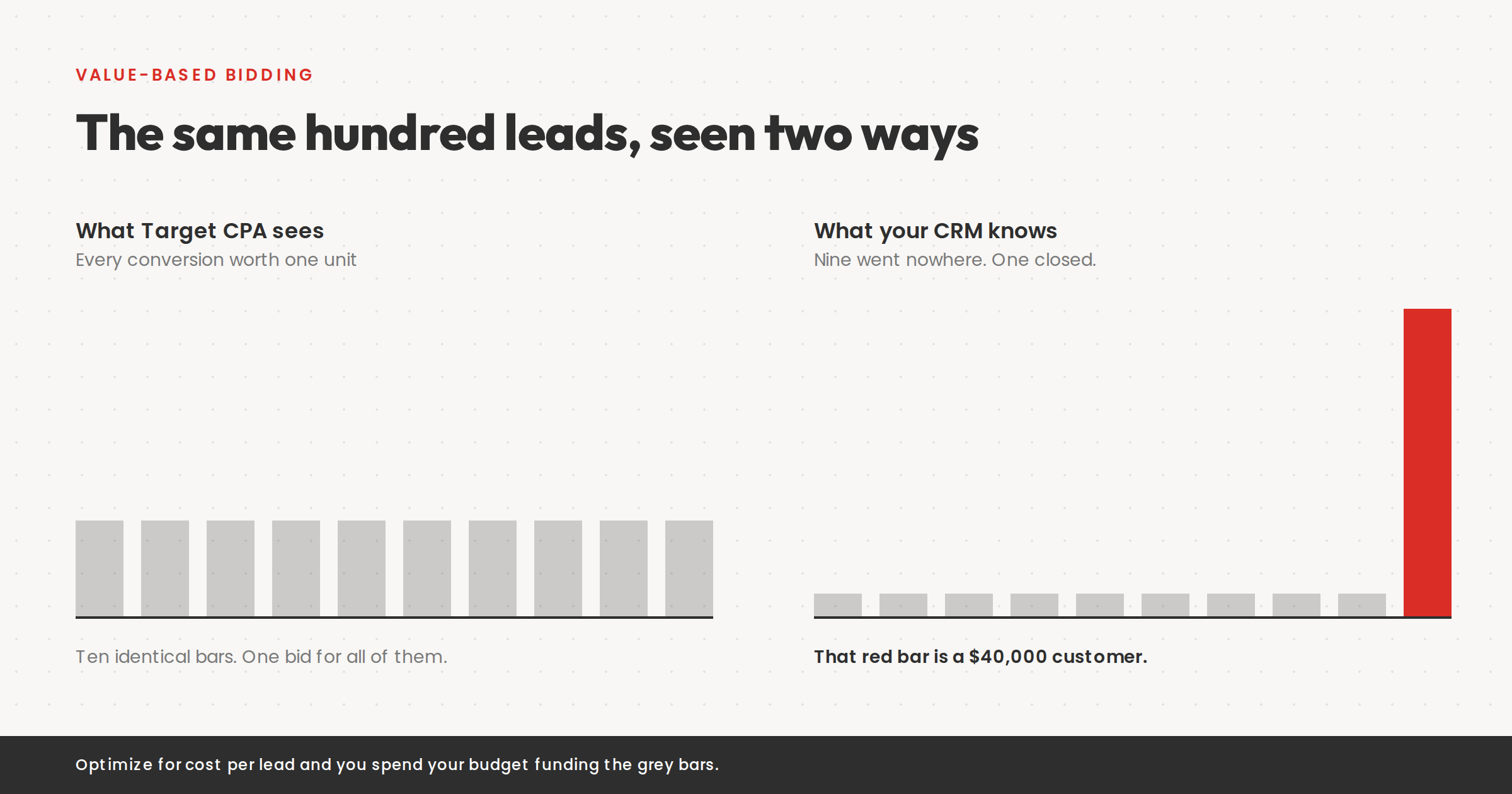
Standard Smart Bidding counts conversions. Maximize Conversions and Target CPA treat every conversion as one unit, worth exactly what every other conversion is worth. Value-based strategies read the dollar amount attached to each conversion and bid accordingly. That single difference is what separates optimizing for lead volume from optimizing for lead revenue.
The two value-based strategies are Maximize Conversion Value and Target ROAS. Both live or die on the numbers you send them.
Google has pushed advertisers this way for years. According to Google Ads Help, Smart Bidding sets bids at auction time using signals like device, location, and time of day. Value is just another signal. It’s the only one that tells Google what the outcome was actually worth.
Conversion count bidding treats a tire-kicker like a whale
Target CPA will happily buy you a hundred leads at $50 each. It has no idea that ninety of them were students, job applicants, and your competitor’s intern. It also has no idea that the other ten closed at $40,000.
This is the central problem in lead gen advertising. Your cheapest leads are usually your worst leads, which means optimizing toward cost per lead actively funds the traffic that wastes your sales team’s afternoons.
The quality problem is well documented. Research from MarketingSherpa found that most B2B organizations pass every inbound lead straight to sales. Only around a quarter of those leads are genuinely qualified. Your bidding algorithm inherits that same blindness unless you fix it.
Ecommerce gets values for free, lead gen does not
An ecommerce store knows the order value at checkout. The number exists the instant the conversion fires, and Google gets a clean signal with zero extra engineering.
Lead gen has no such luxury. Someone fills out a demo request and the value of that event is a complete unknown. It stays unknown for weeks or months, until a rep either closes them or quietly gives up.
That gap between conversion and revenue is the whole problem.
Static conversion values are the most common reason value-based bidding fails
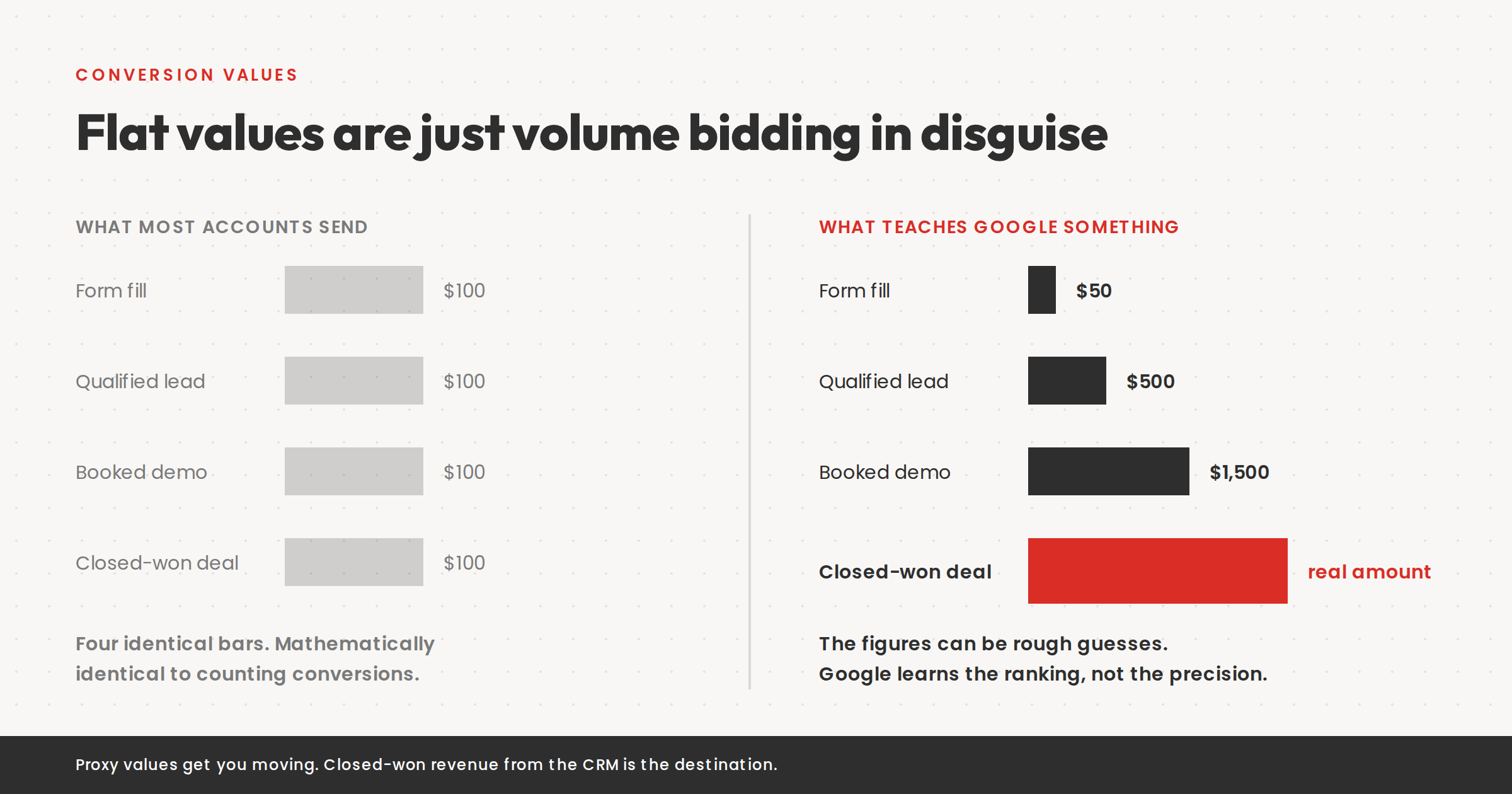
Plenty of accounts technically run Target ROAS on lead gen. Far fewer send values that mean anything. A static value passed on every form fill produces exactly the same behavior as conversion-count bidding, just wearing a different hat. The fix is differentiated values, and you don’t need perfect data to start.
Assigning every form fill $100 teaches Google nothing
If every conversion carries the same value, value-based bidding is mathematically identical to count-based bidding. The algorithm sees flat value and optimizes for volume. You’ve added complexity without adding a single bit of signal.
It’s worth saying plainly because it’s everywhere. Marketers switch on Target ROAS, hardcode a number in the tag, then wonder why performance didn’t move. It never had anything to work with.
Stage-based proxy values beat a flat number
The practical middle ground is assigning different values to different conversion events. A raw form fill might be worth $50. A lead your sales team marks as qualified might be worth $500. A booked demo might be worth $1,500.
These numbers don’t need to be right. They need to be directionally right and applied consistently, because Google learns the relative ranking even when the absolute figures are rough guesses.
Most accounts see a real shift from this step alone. It separates traffic that produces pipeline from traffic that produces noise. Google’s own reporting on value-based Smart Bidding, summarized on Think with Google, points to advertisers gaining roughly 14% more conversion value at a comparable return.
Real closed-won revenue is the destination
Proxy values are a staging post, not the finish line. The version that actually works sends the deal amount from your CRM once the deal closes. Google then knows that a specific keyword produced a specific $40,000 customer.
Getting there takes plumbing.
Google Ads needs an identifier to connect a click to a deal
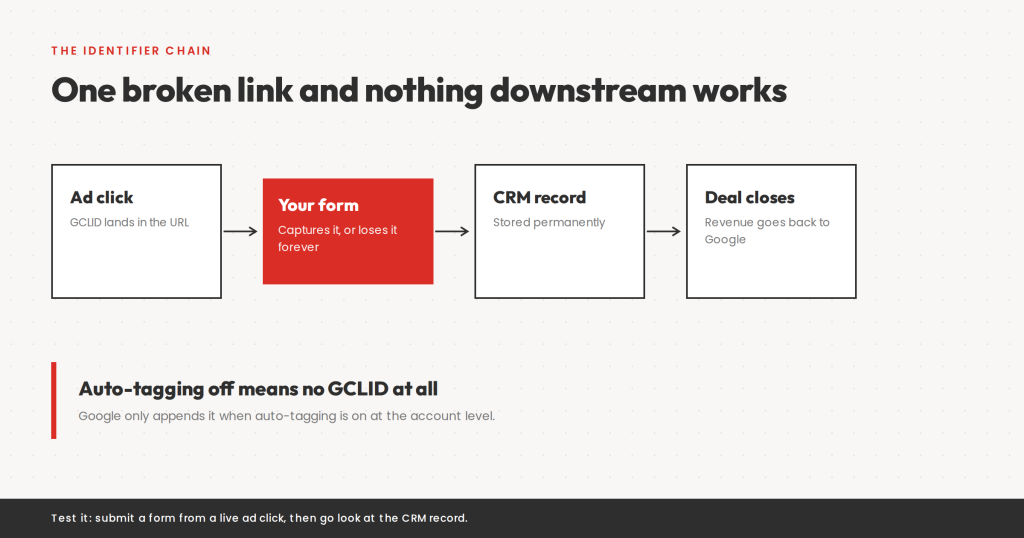
Revenue data is useless to Google unless it can match that revenue to the click that caused it. The match depends on an identifier traveling from the ad click, through your website form, into your CRM, and back out again. Two identifiers do that work: the GCLID and the GA Client ID.
GCLID is the link between the ad click and the CRM record
Every Google Ads click carries a GCLID, short for Google Click Identifier. It shows up in the landing page URL when you switch on auto-tagging, and Google uses it to attribute offline conversions back to the exact campaign, ad group, and keyword.
Auto-tagging isn’t optional here. Google Ads Help is blunt about it: Google only appends the GCLID to your final URLs when auto-tagging is on at the account level. Turn it off and the identifier never reaches your site.
And if your form doesn’t capture the GCLID at submission, it’s gone. The visitor converts, the URL parameter evaporates, and no amount of clever reporting brings it back. Saving the GCLID into a CRM field at lead creation is the whole game.
GA Client ID links the session to GA4
The GA Client ID does a similar job on the Analytics side. It identifies the browser across sessions, and GA4 uses it as the key for stitching later events onto an earlier visit. It’s worth storing the Client ID on the CRM record alongside the GCLID.
This matters if you route revenue through GA4 rather than uploading to Google Ads directly. GA Connector works this way, sending CRM deal data back into GA4 keyed on Client ID. You can then analyze that revenue under any GA4 attribution model, including the data-driven model Google Ads Help now treats as the default for new conversion actions.
Your forms have to carry these fields or nothing downstream works
The capture step is where most implementations quietly break. A marketing team builds out offline conversion imports, gets to the end, and discovers their forms never stored a GCLID in the first place.
Hidden form fields are the traditional method and they work fine. They also mean touching every form on the site and mapping each field in the CRM, which is nobody’s favorite Thursday. Newer API-based approaches match the visitor to the CRM record without form changes, which removes most of that pain.
Check this before you build anything else. Submit a test form from a live ad click and confirm the GCLID landed in the CRM record.
The 90-day attribution window breaks long sales cycles
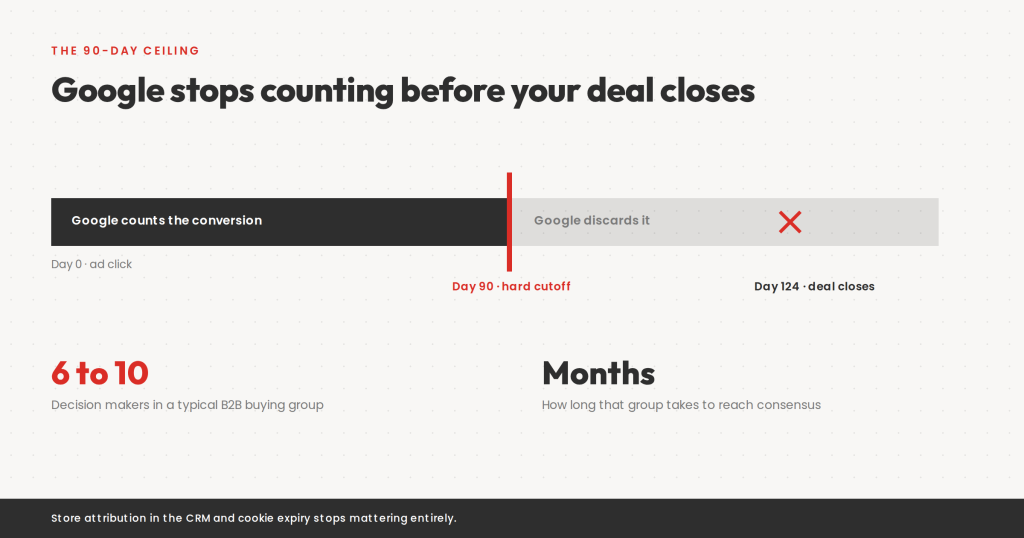
Here’s the limitation that catches out almost every B2B advertiser. Google Ads won’t attribute a conversion that happens more than 90 days after the click. Google doesn’t count offline conversions falling outside that click-to-conversion window. No exceptions, no appeals process.
Long B2B cycles routinely exceed the window
A 90-day ceiling is fine for ecommerce and short-cycle services. It’s a serious problem for enterprise software, construction, legal services, or anything with a procurement department attached.
Blame buying committees. Gartner puts the typical B2B buying group at six to ten decision makers, each showing up with their own research and their own opinions. Consensus takes months, not weeks.
So if your median time to close is four months, most of your real revenue is invisible to Google Ads bidding. The deals that close fastest are the ones Google learns from. Those are rarely your best deals.
Storing attribution in the CRM sidesteps the expiry
The workaround is to stop relying on Google to hold the attribution data at all. Capture source, campaign, and keyword into the CRM at lead creation, and the information lives there permanently.
Cookie expiry stops mattering. A deal that closes 14 months later still carries the campaign that originally produced it. GA Connector was built around this idea, which is why it handles sales cycles beyond 12 months without anything special.
Mid-funnel conversions keep the bidding signal alive
For bidding itself, you still need something inside the window. The usual answer is to optimize toward a mid-funnel event that happens fast enough to count.
Sales-qualified lead, demo attended, proposal sent. All of those tend to land inside 90 days. Feed them a proxy value and use closed-won revenue for reporting and for recalibrating the proxies every quarter.
There are three routes for getting revenue back to Google
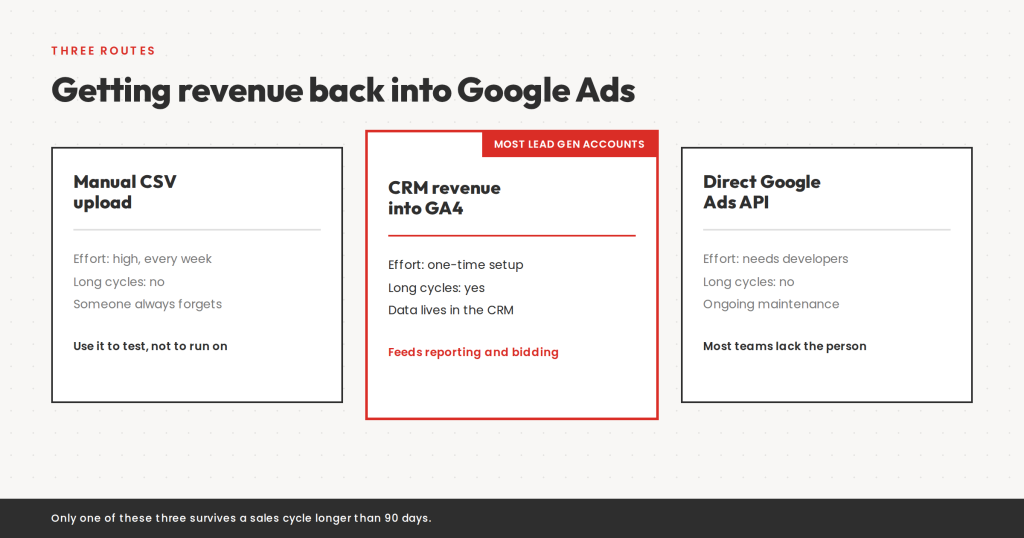
Three routes exist for sending revenue back to Google Ads. You can upload offline conversions manually, route CRM data through GA4 and import it, or write directly against the Google Ads API. They differ in setup effort, ongoing maintenance, and whether they survive a long sales cycle.
| Route | Effort | Handles long cycles | Best for |
| Manual CSV upload of offline conversions | High, recurring | Only within 90 days | Testing the concept |
| CRM revenue into GA4, then import to Google Ads | Medium, one-time setup | Yes, data persists in CRM | Most lead gen accounts |
| Direct API integration with Google Ads | High, needs developers | Within 90 days | Large in-house teams |
Manual uploads prove the concept and then become a chore
Google lets you upload a CSV of GCLIDs and conversion values. It’s free, it works, and it’s a recurring manual task somebody has to remember every single week. That person will forget.
Use it to validate that your GCLID capture is working. Don’t build a long-term process on it.
Routing through GA4 scales better for most teams
Sending CRM deal data into GA4 gives you one pipeline feeding both reporting and bidding. You can import GA4 conversions into Google Ads as conversion actions, and the revenue values come along for the ride.
The side benefit is that the same data powers your Analytics reporting. You get campaign-level revenue in GA4 explorations, not just in the ads interface.
Direct API work is powerful and expensive
Writing directly against the Google Ads API gives you the most control. It also needs engineering time, ongoing maintenance, and someone who genuinely understands both systems.
Most marketing teams don’t have that person. The ones that do usually have bigger fires to point them at.
Conversion volume decides whether value-based bidding will work at all
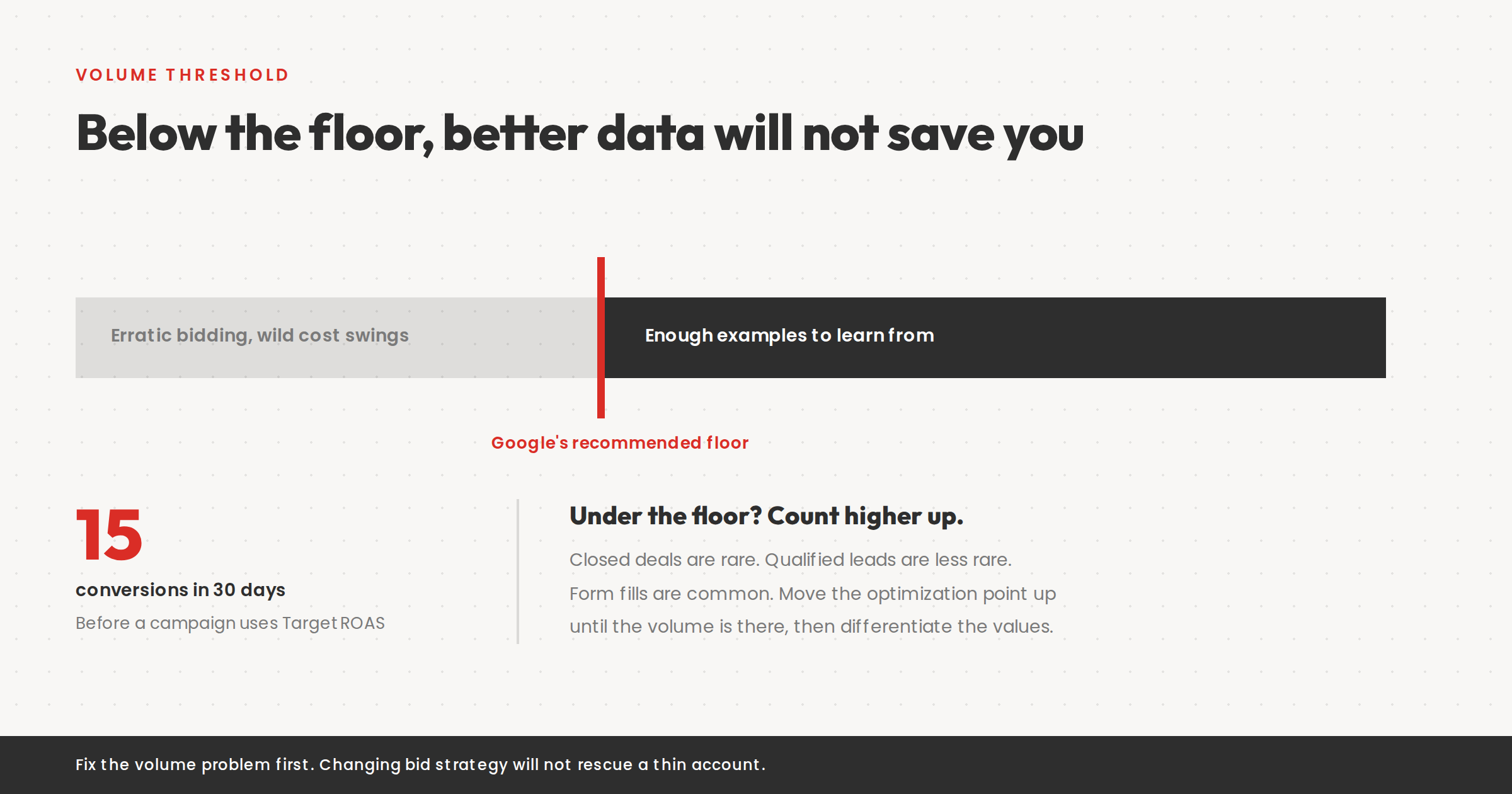
Smart Bidding is a machine learning system, and machine learning needs examples. An account generating eight conversions a month won’t produce a reliable model, no matter how good your value data is. Check that your conversion volume clears Google’s recommended floor before switching strategy. If it doesn’t, move your optimization point higher up the funnel.
Target ROAS needs enough data to learn from
Google publishes a floor for this. We recommend at least 15 conversions in the preceding 30 days before a campaign uses Target ROAS, and notes that performance improves with more.
Thin accounts get erratic bidding and wild cost swings. If you’re under the threshold, fix the volume problem first. Changing the bid strategy won’t rescue you.
Low-volume accounts should count higher up the funnel
If closed deals are too rare, optimize toward something more frequent. Qualified leads happen more often than closed deals, and form fills happen more often than qualified leads.
Move the optimization point up the funnel until you have enough volume, then attach differentiated values to that event so the strategy still has something to rank.
Value tiers work when precise numbers do not
You don’t always need exact revenue. Sorting conversions into three or four value bands captures most of the benefit, and a tiered model is easier to maintain and far less sensitive to one freak deal skewing everything.
Rolling out value-based bidding without wrecking the account
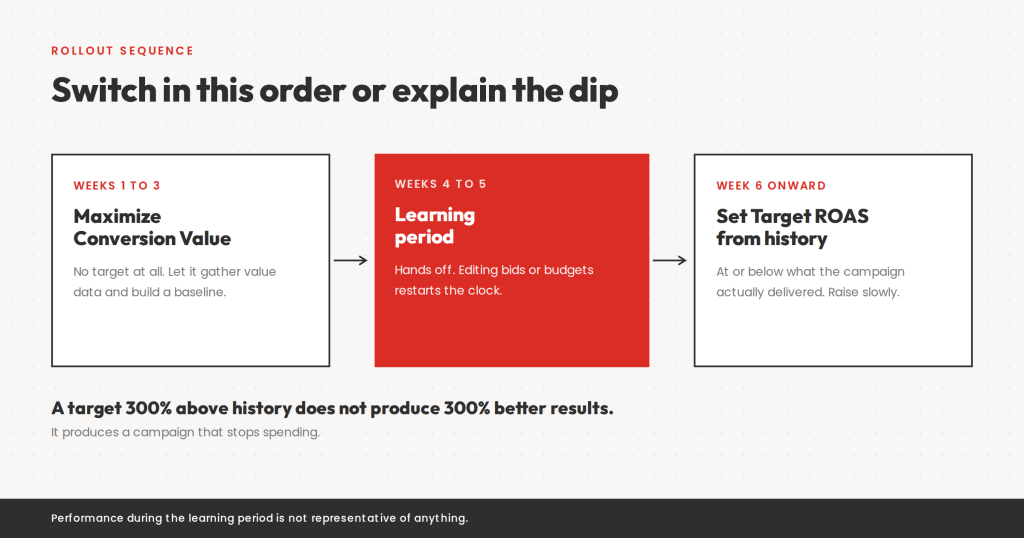
Switching bid strategies resets the learning period, so rollout order matters. Start without a target, gather value data for a few weeks, then set a target based on what the campaign actually delivered. Get this wrong and you’ll spend two weeks explaining a performance dip to someone who doesn’t want to hear about learning periods.
Start with Maximize Conversion Value and no target
Setting an aggressive ROAS target on day one is the classic mistake. Google will throttle spend trying to hit a number it has no evidence it can reach.
Run Maximize Conversion Value first. Let it gather value data for a few weeks. You’ll come out the other side with a baseline ROAS that’s grounded in something.
Set the target from your own history, not your ambition
Pull the actual ROAS the campaign delivered over the last 60 to 90 days. Set your target at or slightly below that figure, then raise it in small increments once performance stabilizes.
A target set 300% above historical performance doesn’t produce 300% better results. It produces a campaign that stops spending.
Expect a learning period and do not intervene during it
Smart Bidding recalibrates after every significant change. It has a learning period that typically runs one to two weeks, and performance during that window doesn’t mean much.
Editing bids, budgets, or targets mid-learning restarts the clock. Leave it alone. I know that’s the hardest part.
Your reporting changes once the values are real
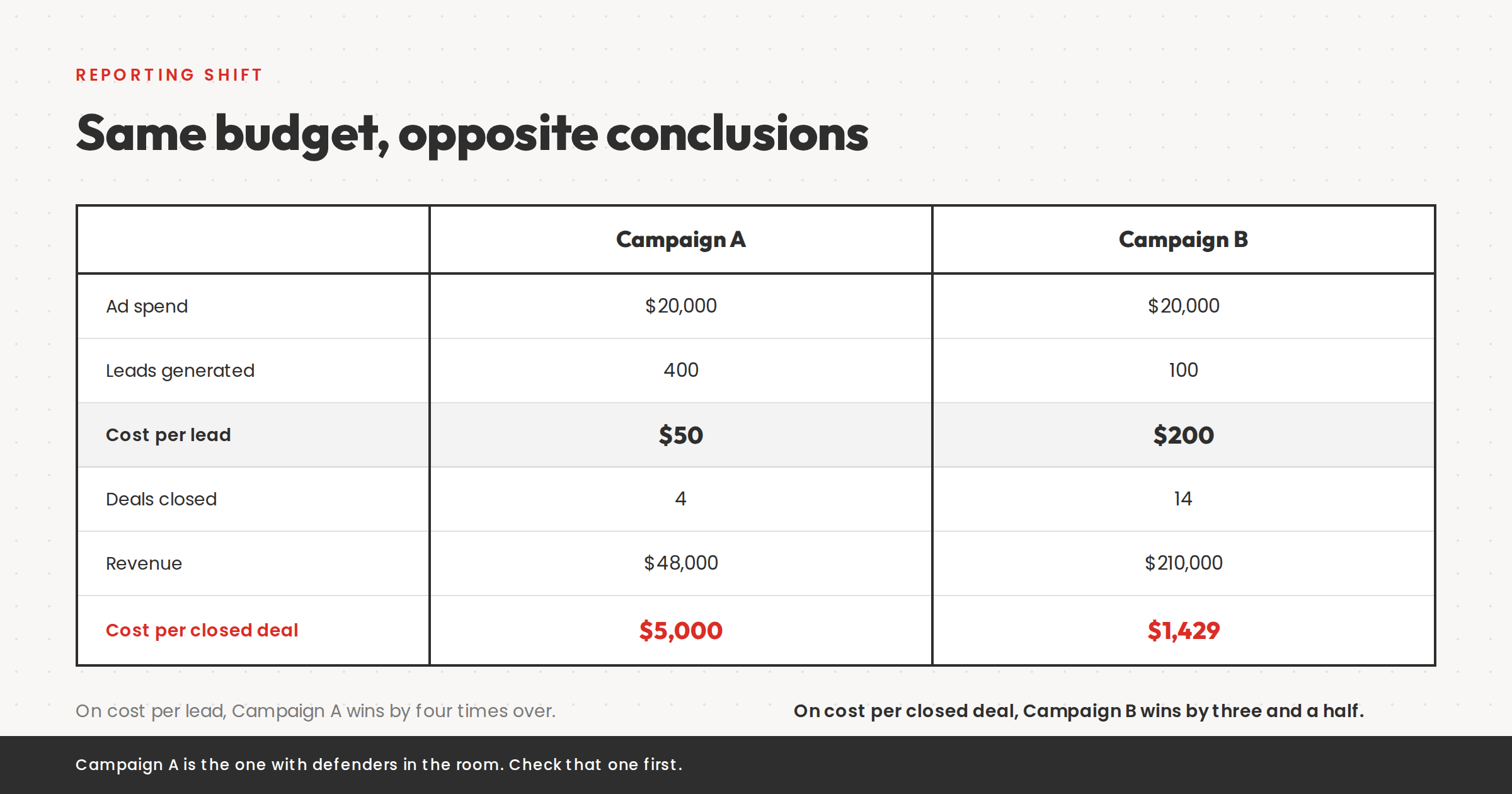
Once conversion values reflect real revenue, your reporting metrics change. Cost per lead stops being the headline number and cost per closed-won deal replaces it. Campaigns that looked efficient on CPL frequently turn out to contribute almost nothing. That reckoning is the point of the whole exercise.
Cost per lead stops being the headline number
CPL rewards cheap traffic. Once you can see revenue by campaign, you’ll find campaigns with beautiful CPL and terrible revenue contribution.
Those campaigns usually have defenders inside the company. The data makes that conversation much shorter.
Cost per closed-won deal becomes the metric that matters
What you actually want is the cost to acquire a customer, broken out by campaign, ad group, and keyword. That number only exists when your CRM outcomes connect back to ad spend, which is the basic premise behind closed-loop reporting.
Some teams run this as a single quarterly review. They ask which keywords produced the most profitable customers, move the budget, and get on with their lives.
Bad campaigns get exposed quickly
The most common outcome is deeply unglamorous. A campaign everyone assumed was working turns out to generate volume and no revenue. Budget moves elsewhere, total revenue rises, total spend doesn’t change. NetReputation found seven figures of waste doing exactly this.
That’s the return on this work. Not a smarter algorithm, just one that finally knows what you sell.
FAQ
What is value-based bidding in Google Ads?
Value-based bidding is a Smart Bidding approach that optimizes toward conversion value rather than conversion count. Maximize Conversion Value and Target ROAS are the two strategies. Both require you to send a monetary value with each conversion.
Which Smart Bidding strategy optimizes for value?
Target ROAS and Maximize Conversion Value both optimize for value. Target ROAS aims for a specific return figure. Maximize Conversion Value spends the full budget chasing the highest total value available.
Can value-based bidding work for lead generation?
Yes, but it takes more setup than ecommerce. You need to capture GCLID at form submission, track the deal outcome in a CRM, and send a value back to Google. Without that chain, the strategy has no values to optimize toward.
How long does Google Ads attribute offline conversions?
Google Ads attributes offline conversions for up to 90 days after the click. Google doesn’t count conversions falling outside that window. Businesses with longer sales cycles usually optimize toward a mid-funnel event instead.
Do I need enhanced conversions for value-based bidding?
No. Enhanced conversions improve measurement accuracy by sending hashed first-party data. They complement value-based bidding rather than enabling it. GCLID capture is the requirement that actually matters.
What conversion value should I use if I do not know the deal size yet?
Use a proxy based on historical averages for that conversion stage. Multiply your average deal value by the historical close rate for that stage, then refine the figure as real closed-won data accumulates.