Multi-touch attribution is a marketing attribution model that splits conversion credit across several interactions rather than handing it all to a single click. First-touch and last-touch attribution are simpler, well-established starting points — and for many businesses, they are exactly the right tool. But when buyers take longer to decide, use multiple channels, and need several nudges before converting, single-touch models start to leave gaps. That is when multi-touch attribution earns its place.
Understanding First-Touch, Last-Touch, and Everything In Between
First-touch and last-touch attribution are both single touch attribution models and they both answer a real question. First-touch tells you what originally brought someone into your world. Last-touch tells you what finally pushed them over the line. Both are valuable, both are easy to act on, and both work well when the path from awareness to conversion is relatively short. Understanding marketing attribution models — from single-touch to multi-touch — is the foundation for making any of these decisions well.
The limitation only appears when the journey stretches out. If a buyer takes weeks, visits multiple times, and engages across several marketing channels before converting, crediting only the first or last interaction means you are making decisions with a partial view. You might keep funding what closes deals while slowly defunding what generates them.
That is not a flaw in first-touch or last-touch as concepts. It is just the natural ceiling of any single-touch model when applied to a complex, multi-step buying process.
When Multi-Touch Attribution Starts to Matter
Multi-touch attribution models try to show the full conversion path. It looks at the touches that introduced, educated, nurtured, and closed the buyer — then assigns fractional credit across those multiple touchpoints instead of concentrating it all in one place.
This becomes useful when your marketing channels play genuinely different roles. If paid social keeps showing up early in paths that eventually close, and email keeps re-engaging people who went quiet, that should affect how you think about marketing budgets. Single-touch models will not show you that. Multi-touch will.
The practical benefit is better channel contribution decisions across marketing campaigns. Instead of asking “which channel closed the deal,” you start asking “which channels built the deal” — and the answers are often different.
Why This Matters for Budget Allocation
Marketing channels do different jobs. Some create awareness. Some build trust. Some capture intent. If you judge every channel purely by whether it was the last touch before conversion, you will keep rewarding the ones that show up at the finish line while underfunding the ones that got the buyer there.
Consider a B2B SaaS funnel. A podcast ad gets the first visit. LinkedIn drives a return session. Email gets the webinar signup. Branded search gets the demo request. Under last-touch attribution, branded search gets all the credit — and your marketing strategies end up underfunding the channels that made the whole sequence possible.
Companies using attribution effectively see 15–30% higher marketing ROI than those relying on fragmented measurement, according to Digital Applied. That is not because attribution is magic. It is because better measurement leads to less waste.
How Multi-Touch Attribution Works
Multi-touch attribution works by collecting every measurable interaction before conversion, then applying a model to split credit across the journey. The result is a more complete picture of what drove the sale — but only as complete as your tracking allows.
What Counts as a Touchpoint
A touchpoint is any measurable interaction before conversion: an ad click, a landing page visit, an email open, a webinar registration, a sales call logged in the CRM. The hard part is not the definition — it is capturing UTM parameters and tracking consistently across all of them.
In practice, most teams track what they can actually capture. Website sessions, CRM events, form fills, and ad clicks are common. View-through impressions and cross-device behavior are where things get messy.
According to Mediahawk’s 2025 State of Call Tracking survey, 79% of marketers say achieving 100% attribution across all marketing touchpoints is a challenge. Your model is incomplete. Welcome to marketing in the real world.
That is why input quality matters so much. If Meta counts views, Google counts clicks, and your CRM only knows about form fills, your cross-channel attribution starts from uneven data. Bad inputs create very confident nonsense.
How Credit Gets Assigned
A marketing attribution model is a rule for splitting credit across the journey. It is not truth. It is a framework.
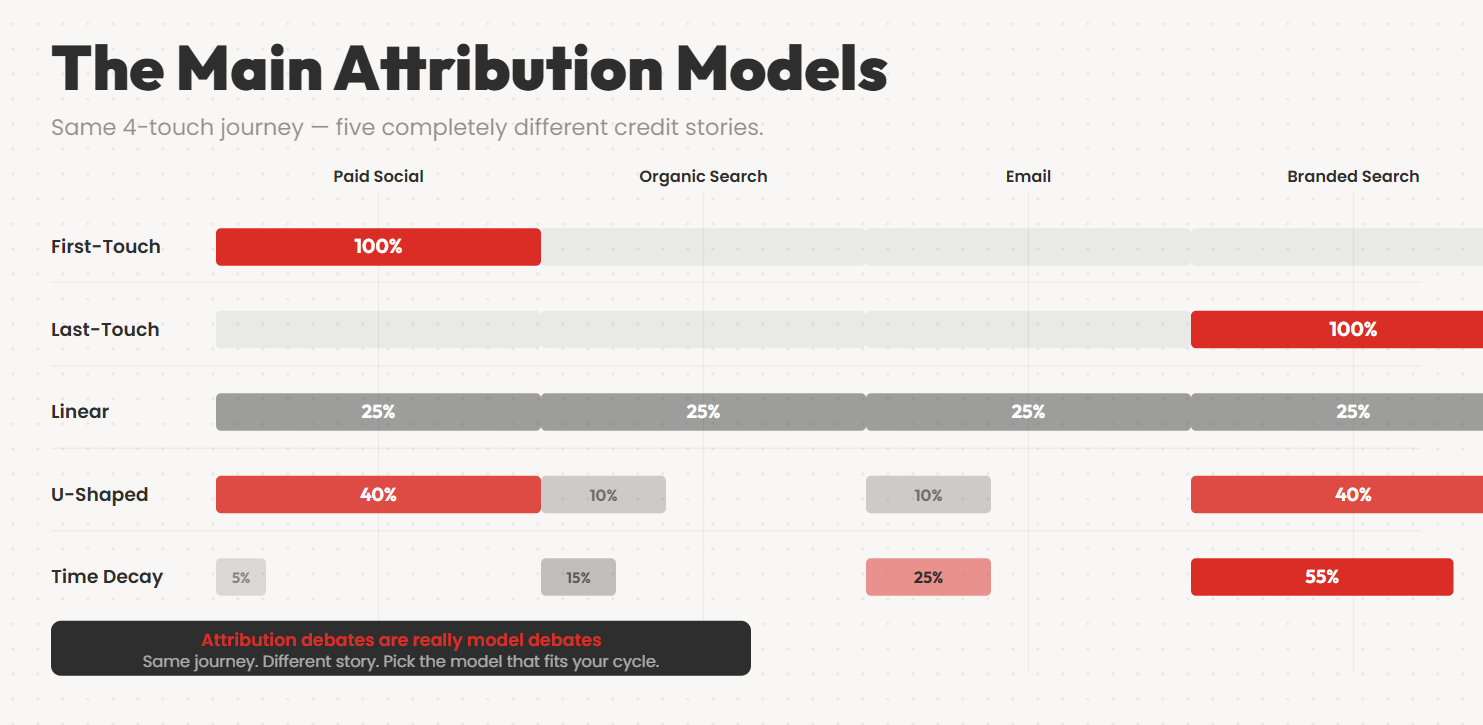
A linear attribution model gives equal credit to every touch. Time decay attribution gives more credit to touches closer to conversion. Position-based attribution gives extra weight to key moments — like the first and last touchpoints and lead creation. Each tells a slightly different version of the same story.
A Real Campaign Path
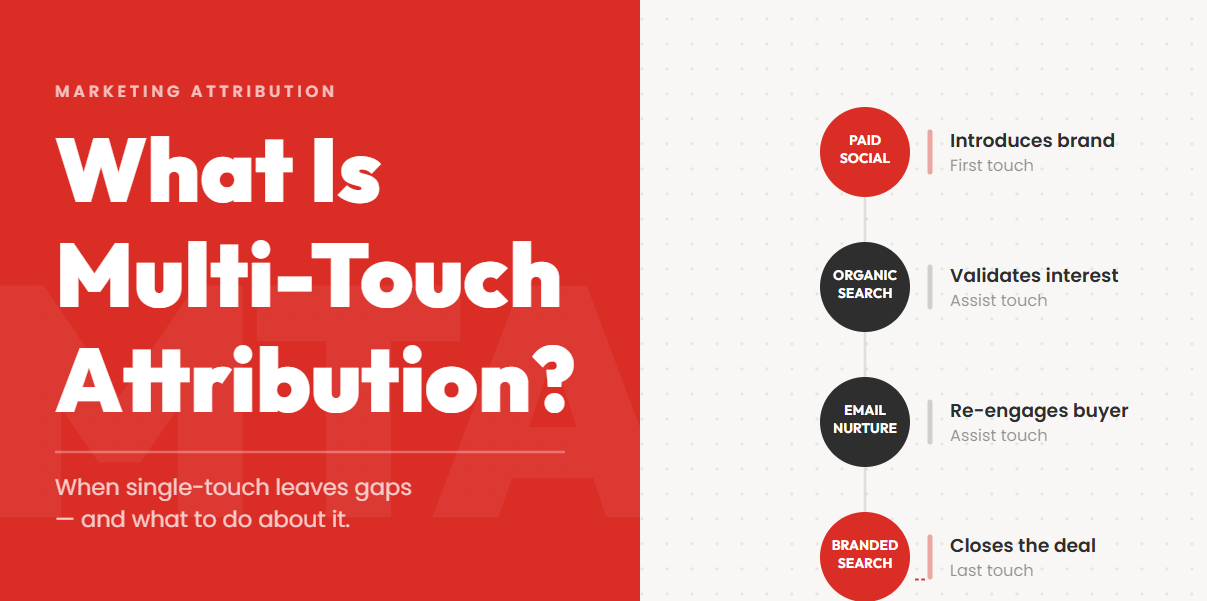
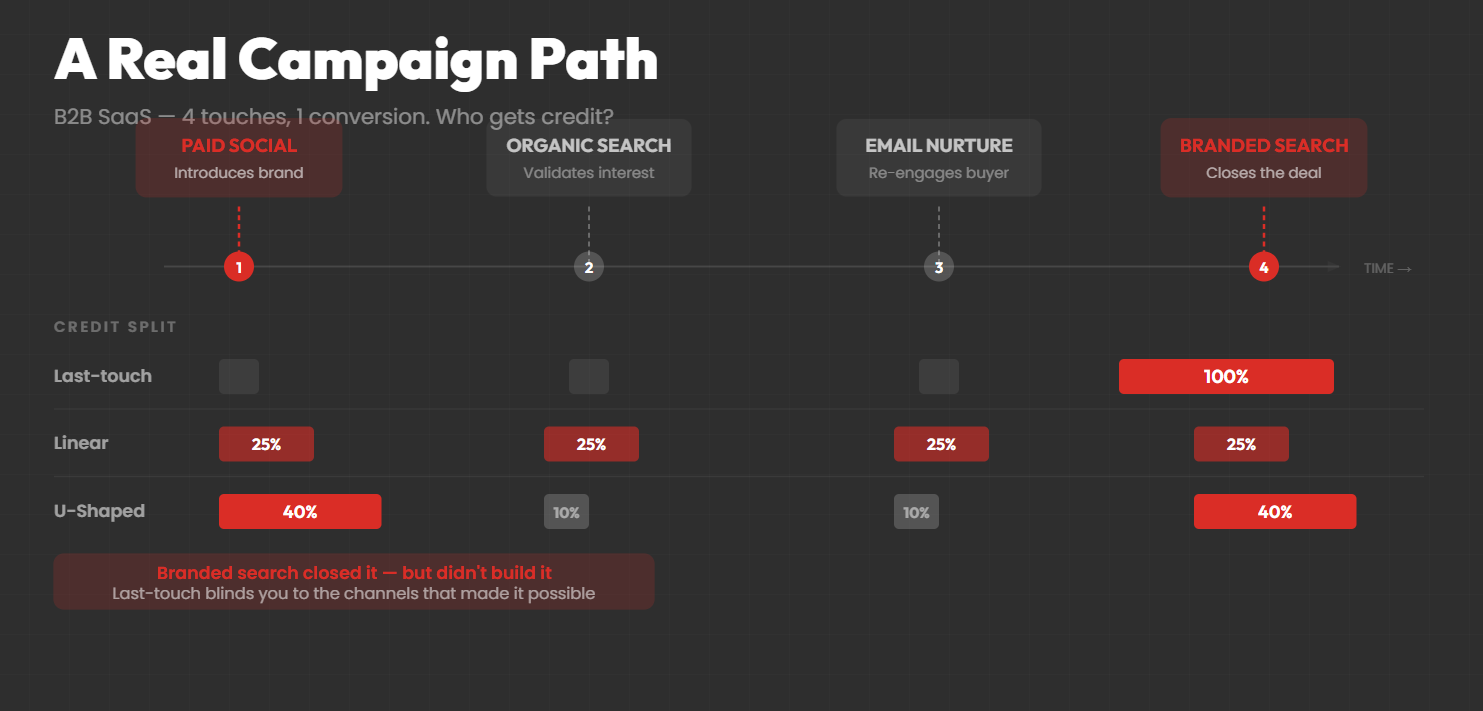
Say a prospect becomes a sales-qualified lead after four touches. Paid social introduces the brand. Organic search brings them back. Email gets the webinar signup. Branded search captures the demo request.
Under last-touch attribution, branded search gets 100% of the credit. Under a linear model, each touch gets 25%. Under time decay, the last two touches get more weight. Same journey. Different story. This is why attribution debates are often really model debates.
The Main Attribution Models
Each model tells a different version of the same journey. The right choice depends on your sales cycle, your team’s trust in the model, and how closely it maps to the stages your business actually cares about.
First-Touch and Last-Touch Attribution
First-touch attribution credits the channel that originally brought the buyer in. Last-touch credits whatever drove the final conversion. Both are simple, transparent, and easy to act on — which is why they remain the most widely used models.
They work best when your sales cycle is short, your funnel is relatively linear, and your team needs clear, actionable signal without a lot of modelling complexity. For businesses just getting serious about measurement, first and last touch provide a solid foundation before adding more layers.
Linear Attribution
Linear attribution gives equal credit to every tracked touch. If there are four touches, each gets 25%. It is a natural bridge between single-touch simplicity and more sophisticated multi-touch models.
The downside is obvious: not every touch matters equally. A random blog visit should not count the same as a demo request. But for teams taking their first steps toward customer journey attribution, linear is often good enough to expose obvious channel assists.
Time Decay Attribution
Time decay attribution gives more credit to touches closer to conversion. The logic is that later touches often happen when intent is stronger.
This works well for shorter sales cycles or high-intent funnels. The catch is that it can undervalue demand generation. If YouTube, paid social, or content got you on the shortlist, time decay may make those channels look weaker than they are. It can become last-touch with better manners.
Position-Based Models: U-Shaped and W-Shaped Attribution
Position-based attribution gives extra weight to specific moments in the journey. U-shaped attribution typically gives the most credit to the first and last touchpoints — the introduction and the close. W-shaped attribution adds a third weighted milestone, usually lead or opportunity creation.
These models are popular in B2B because they line up with how revenue teams actually think. Sales cares about lead creation. Marketing cares about first touch. Revenue leaders care about pipeline progression. A position-based model gives each of those moments some respect.
According to Nielsen’s 2025 Marketing ROI Blueprint, 22% of marketers cite stakeholder alignment across key metrics as their top challenge in measuring ROI. That is why position-based models often win internally — they are not just measurement tools, they are peace treaties.
Data-Driven Attribution
Data-driven attribution uses observed behaviour to estimate which touches are more likely to contribute to conversion. In theory, this is smarter than fixed rules because it uses actual path data. In practice, it depends on volume, clean tracking, and a platform you trust.
For large accounts, data-driven attribution can be very useful. For smaller teams, it can become a black box. And if the ad platform is also the one assigning the credit, keep your eyebrows raised.
This is also where incrementality vs attribution matters. Attribution tells you which touches appeared in the path. Incrementality asks what would have happened without that touch. Those are not the same thing — and both questions matter for well-grounded marketing strategies.
When Multi-Touch Attribution Actually Matters
It matters most when buyers take time, use multiple channels, and need several interactions before converting. The more complex the journey, the more single-touch models distort your view of what is actually working.
Long Sales Cycles
The longer the sales cycle, the more dangerous single-touch reporting becomes. More time usually means more research, more channels, and more chances for the final click to take credit for work done much earlier.
If you sell software, healthcare, education, financial services, or anything expensive, buyers typically need several interactions before committing. Multi-touch attribution adoption reached 47% of B2B teams in April 2026, up from 31% in 2023, according to Digital Applied — and the growth is concentrated in exactly these longer-cycle categories.
When Multiple Channels Work Together
Cross-channel attribution matters when channels play different roles across the funnel. One introduces. Another educates. Another captures intent. Another reactivates.
Take a common setup: YouTube drives awareness. A Facebook ad retargets the visit. Google Search captures demand. Email nudges the final action. Under last-touch attribution, upper-funnel channels look lazy and lower-funnel channels look heroic.
According to Singular’s ROI Index 2026, multi-touch attribution revealed Meta with up to 50% higher ROAS compared to last-touch methodology in large-scale campaign analysis. That is a substantial correction — and it shows how badly single-touch models can undercount channels that assist rather than close.
Lead Generation vs. Ecommerce
Lead gen usually benefits more from multi-touch attribution than ecommerce does. Lead gen has more friction, more stakeholders, and more mid-funnel activity — content, comparison, retargeting, email nurture, and sales follow-up all in the mix.
In ecommerce, paths tend to be shorter for lower-priced products. In lead gen, you do not just want to know what got the form fill. You want to know what produced leads that did not waste sales time. This is where closed loop marketing — connecting web activity all the way through to CRM revenue — becomes essential.
When It Is Probably Not Worth the Hassle
If your path is short, your budget is small, and your tracking is a mess, keep it simple. A complicated model on bad data is still bad data — it just comes with more charts.
If one channel clearly dominates and most conversions happen after one or two touches, the extra setup may not pay off. There is no trophy for building an attribution machine nobody trusts.
The Biggest Problems with Multi-Touch Attribution
Even well-built attribution models have blind spots. Tracking breaks, platforms inflate their own numbers, and offline behaviour stays mostly invisible. Knowing where the model fails is just as important as knowing where it helps.
Tracking Is Messy
Cookies break. People switch devices. Privacy rules limit visibility. Platforms keep more data inside their own walls.
That means your conversion path is often incomplete. You may see the search click and the form fill, but miss the podcast impression, the mobile visit, or the offline conversation that made the buyer trust you. According to Mediahawk’s 2025 survey, 79% of marketers say getting full attribution across all touchpoints is a challenge. Your model has blind spots — pretending otherwise is how teams end up worshipping bad data.
Attribution window length shapes what the model can even see. If your window is too short, early touches disappear entirely.
Platform Reports Are Not Neutral
Every platform wants to prove it drove the sale. Meta says it helped. Google says it helped. LinkedIn says it helped. Somehow everyone won the same conversion.
Platform reporting is useful for in-platform optimisation. It is not a reliable source of truth for cross-channel attribution. If you add up every platform’s self-reported conversions, you often get a number that belongs in fantasy football. Your CRM, analytics stack, or data warehouse should be the referee.
According to McKinsey’s March 2026 commerce media report, 50% of advertisers say improved measurement capabilities would unlock incremental investment. People want to spend more — they just do not trust the measurement enough yet.
Offline and Brand Effects Stay Mostly Invisible
Not everything important is trackable. A buyer might hear about you on a podcast, ask a colleague, see your booth at an event, then convert through search. Your attribution system may only capture the search click.
Brand effects are even harder to capture. Brand often makes every other channel work better, but path-based models struggle to show that clearly. Multi-touch attribution is one useful lens, not the whole truth — and it works best when paired with broader measurement approaches like marketing mix modelling.
Teams Misuse Attribution Data
Attribution looks precise, and people love false certainty. A dashboard says paid search got 38% of pipeline credit, so everyone acts like that number came down from a mountain.
It did not. It came from a model, with assumptions, over a chosen attribution window, using incomplete data. That is useful — but it is not gospel.
According to Nielsen’s 2025 Marketing ROI Blueprint, 85% of marketers feel confident in tracking holistic performance, but only 32% actually measure holistically. That gap is where a lot of bad decisions live.
How to Use Multi-Touch Attribution Without Getting It Wrong
Attribution is most valuable when teams treat it as a decision aid, not a scoreboard. The goal is better budget calls, not a cage match between channel managers.
Treat It as Directional, Not Definitive
You are looking for patterns, not commandments. If a channel keeps showing up early in high-quality paths, that matters. If another mostly appears at the end, that matters too.
Use attribution to understand channel contribution across your marketing efforts. Do not use it to declare one team the winner. The point is to make better decisions about marketing budgets — not pit demand gen against paid search.
Combine It with Other Signals
Pair attribution with incrementality thinking, lead quality data, and actual business outcomes. Attribution shows what appeared in the path. Incrementality helps you test what truly changed outcomes.
If attribution says a channel matters, check whether sales says the leads are good. Check whether conversion rates hold after budget shifts. Path visibility and lift testing should work together, not compete.
What “Good Enough” Looks Like for Most Teams
For most teams, good enough means clean UTMs, CRM integration, clear lifecycle stages, and one model everyone understands. You do not need a PhD-level setup. You need discipline.
A simple linear model or position-based attribution setup in your CRM is often enough to spot obvious waste and surface hidden channel assists. If your naming conventions are a disaster and your lifecycle stages are fuzzy, fix those first. Start by making sure you are reliably tracking UTM parameters in your Salesforce forms — or whichever CRM you use — before worrying about model selection.
Before Changing Budgets Based on Attribution
Look for repeated patterns over time. One month is noise. Three to six months is more useful. Segment by lead quality, pipeline, and revenue — not just raw conversions.
Sanity-check the numbers against reality. If attribution says webinars are crushing it, but half the attendees are students and competitors, do not double the spend yet. Common sense still beats a pretty chart.
Multi-Touch Attribution in Practice
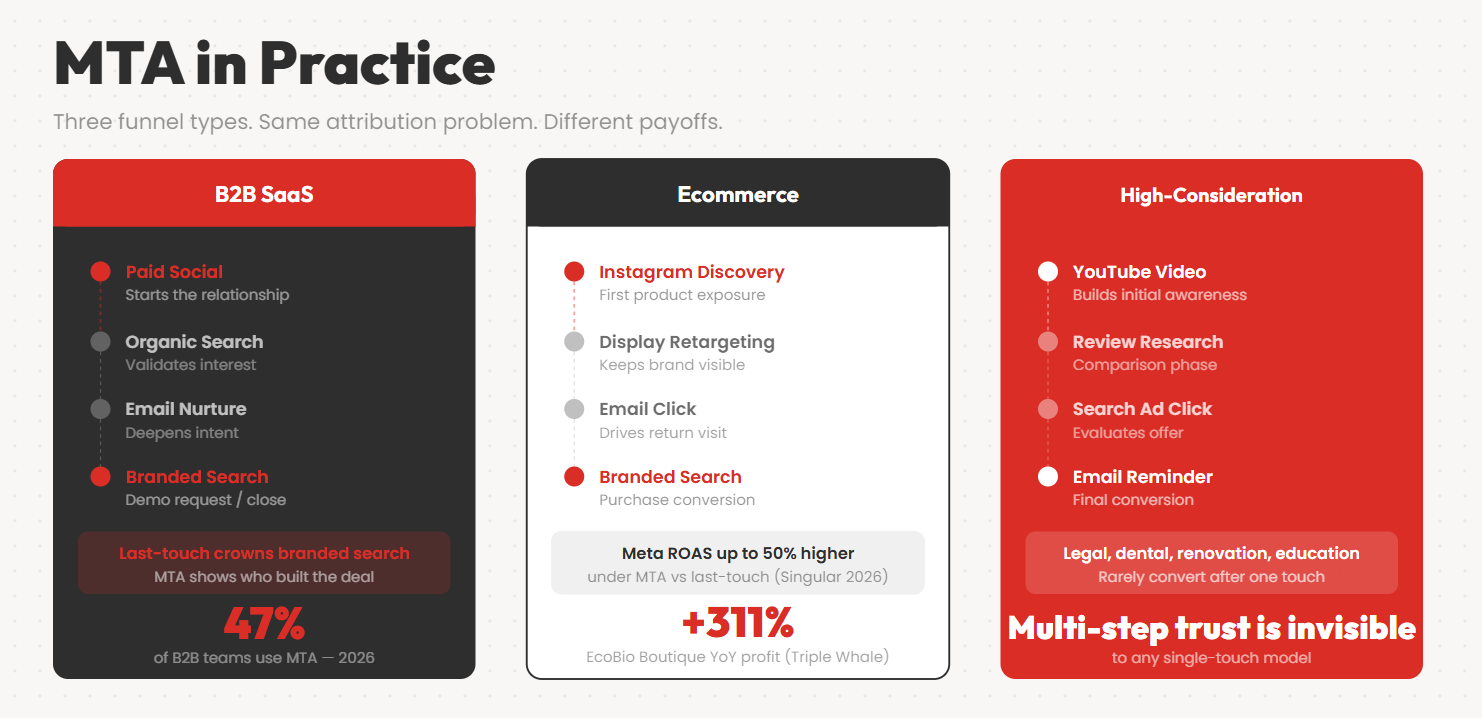
The same principles play out differently depending on the funnel. B2B SaaS, ecommerce, and high-consideration consumer categories each have their own version of the attribution problem — and their own version of the payoff.
B2B SaaS
A typical B2B SaaS journey is messy. Paid social starts the relationship. Organic search validates interest. Email nurtures over weeks. A webinar deepens intent. Branded search or direct traffic often gets the final conversion.
Under last-touch attribution, branded search looks like the hero. But that misses the sequence that created the opportunity. This is why lead-to-revenue attribution matters in SaaS more than simple lead counting — and why 47% of B2B teams now use multi-touch models, up from 31% in 2023, according to Digital Applied.
Ecommerce with Remarketing
In ecommerce, a shopper might discover a product through Instagram, browse twice, get retargeted on display, click an email, then buy after searching the brand. Last-click usually hands the win to email or branded search.
That leads teams to pump discounts and branded search while cutting prospecting spend. Then new customer volume dries up a few weeks later and everyone acts shocked. It is the marketing version of eating your seed corn.
According to Singular’s ROI Index 2026, multi-touch attribution revealed Meta with up to 50% higher ROAS than last-touch methodology — exactly the correction ecommerce teams need when prospecting gets undervalued. EcoBio Boutique cut blended CPA by 33%, increased blended ROAS by 55%, and boosted profit by 311% year over year using Triple Whale’s multi-touch attribution tools. That is what better full-funnel measurement can unlock when the team actually acts on it.
Local Services and High-Consideration Consumer Categories
Think legal services, cosmetic dentistry, home renovation, or private education. People rarely convert cold after one touch. They research, compare, ask around, and come back later.
A prospect might see a YouTube video, read reviews, click a search ad, visit twice, then submit a form after an email reminder. If you only credit the final source, you miss what built trust across the whole sequence.
Even partial customer journey attribution is better than pretending the final click created all the demand. Understanding which channels assisted — and which closed — changes how you think about where to put your marketing budgets next quarter.
Frequently Asked Questions
Is multi-touch attribution better than last-click attribution? It depends on your journey complexity. For short, simple funnels, last-click is often perfectly adequate. For longer cycles with multiple channels, multi-touch gives a more complete picture of what is actually driving conversions.
Is multi-touch attribution the same as marketing mix modelling? No. Multi-touch attribution is path-based and user-level. Marketing mix modelling is broader and aggregate — better suited to measuring brand effects and offline channels. They answer different questions and work best in combination.
Can small businesses use multi-touch attribution? Yes, but keep it simple. Start with CRM data, clean UTMs, and a basic model. You do not need enterprise software to understand channel contribution across your marketing campaigns.
What is the right attribution model? There is no universal answer. The right attribution model fits your sales cycle, channel mix, and data quality — and is simple enough that your team will actually trust it.
Should you trust platform-reported attribution? Not as your only source of truth. Use platform reports for in-platform optimisation. Use your CRM or data warehouse to referee cross-channel performance.
What is the biggest mistake teams make with multi-touch attribution? Treating it like exact truth. Attribution is a decision aid, not a religion. According to Nielsen’s 2025 Marketing ROI Blueprint, only 32% of marketers actually measure holistically, even though 85% feel confident they do.
The Bottom Line
First-touch and last-touch attribution are not broken — they are the right starting point for most teams, and they answer genuinely important questions. Multi-touch attribution adds value when those questions are no longer enough: when your buyers take longer, your channels do different jobs, and understanding the full path would change your budget decisions.
It is not perfect. It is model-driven, incomplete, and easy to misuse. But it gives you a more complete map of how your marketing efforts actually combine to drive revenue — and that is worth having when the journey is complex enough to warrant it.
Invest in multi-touch when your journeys are long, your mix is broad, and your marketing budgets depend on understanding assists — not just closers.
Track attribution from first click to closed deal with GA Connector.
GA Connector natively captures first-touch and last-touch attribution for every lead — passing source, medium, campaign, keyword, and more directly into your CRM alongside each contact. For teams ready to go further, our multi-touch attribution add-on works within GA4 to give you a complete view of the channels and content that influenced each conversion, not just the one that closed it.
Start your free trial of GA Connector →