Closed loop reporting is the practice of connecting marketing and sales data so you can see which channels actually produce paying customers, not just leads. It works by linking a lead’s original traffic source to the deal it eventually becomes inside your customer relationship management software. Practitioners need it because without that link, marketing spend decisions are guesses.
According to Gartner, B2B buyers spend only about 17% of their total purchase journey meeting with potential suppliers. Most of the decision happens across marketing channels that sales never sees recorded against a deal. Closed loop reporting is what reconnects those touchpoints to the outcome, and honestly, most companies don’t find out how badly disconnected their marketing and sales teams are until they try to build their first report.
What Closed Loop Reporting Means
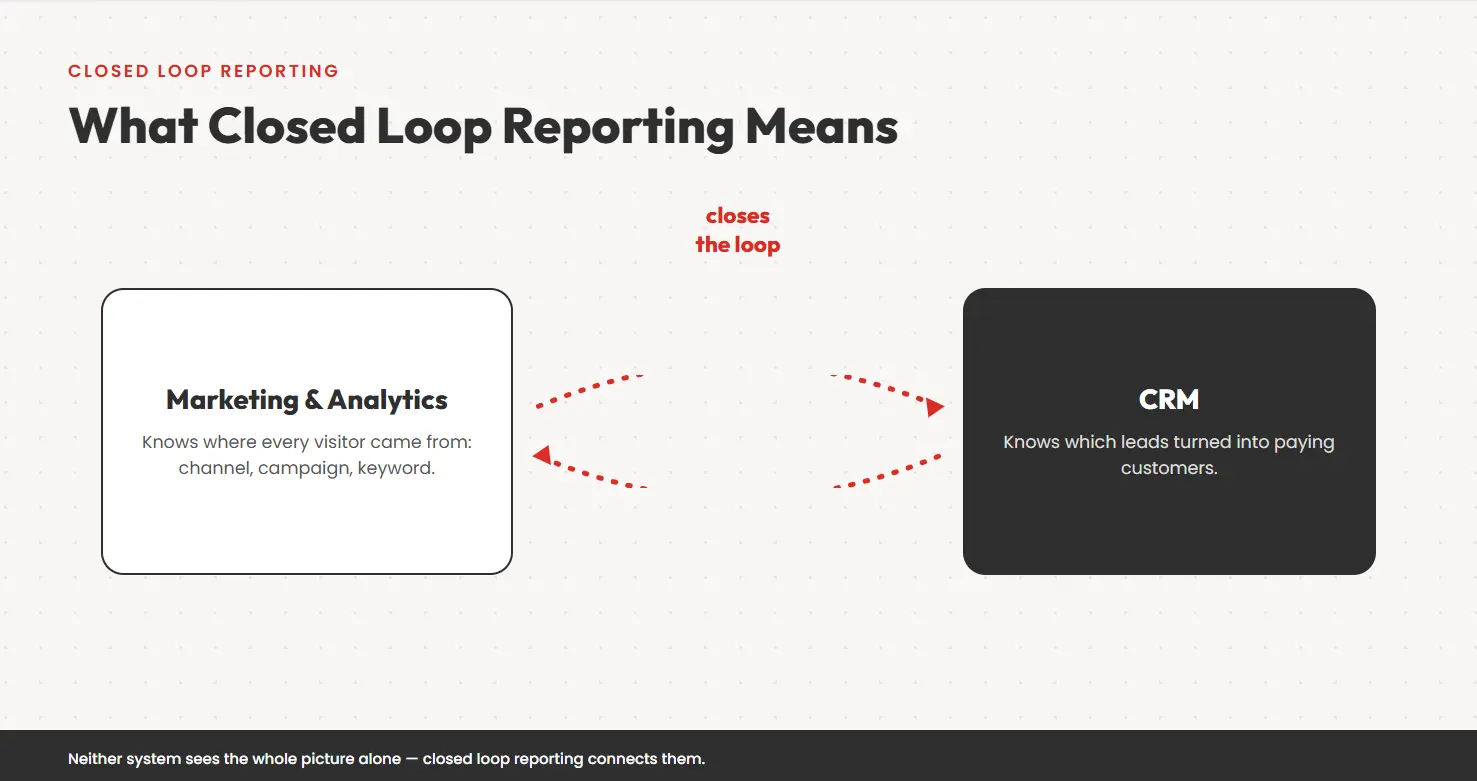
Closed loop reporting fills the gap between two systems that normally don’t talk to each other. Marketing automation tools and analytics platforms track where leads come from. CRMs track which leads turn into revenue. Neither one sees the whole picture of customer data on its own.
You’ll also see this called closed-loop marketing, especially when people are talking about the broader marketing strategy rather than the reporting mechanics specifically. The terms overlap heavily. Closed loop marketing describes the philosophy of connecting cause to effect across the customer journey; closed loop reporting is the actual data plumbing that makes it possible.
The Marketing-Sales Disconnect
Marketing teams optimize for lead volume and cost per lead. Sales teams optimize for closed deals. When these two functions run on separate data, marketing can hit its lead targets while sales drowns in unqualified leads that never convert. Nobody notices until the quarter is already over, and by then everyone’s arguing about whose fault the missed number is.
This is, at its root, a marketing and sales teams alignment problem disguised as a data problem. Give both sides the same numbers and most of the arguing stops on its own.
Why “Closing the Loop” Is the Right Metaphor
Picture a circuit. A visitor clicks an ad, lands on your site, fills out a form, becomes a lead, and eventually closes as a customer or doesn’t. Without a closed loop system in place, that circuit breaks the moment the lead enters your CRM. Closing the loop means the deal outcome flows back to the original marketing touchpoint, completing the circuit and creating a continuous feedback loop that gets smarter with every deal that closes.
How Closed Loop Reporting Works
Four steps, in order: attribute the visit, capture the lead, track the deal, send revenue back to the source. Skip one and the chain breaks before it ever reaches a report you can trust.
Step One: Attribute the Visit
When someone lands on your site, a tracking script captures how they got there: the channel, campaign, keyword, and referring URL. This data typically lives in a first-party cookie or local storage attached to that visitor.
Third-party cookie deprecation has pushed more attribution tools toward first-party tracking. Browsers now block third-party cookies by default for a growing share of users. That shift has made server-side and first-party tracking the more reliable foundation for any attribution setup built today.
Step Two: Capture the Lead
When the visitor fills out a form, their source data gets attached to the new lead or contact record in your CRM. This is the step most tools get wrong. Many only capture last-click data, which means a visitor’s first interaction with your brand, often the one that actually built trust, gets no credit. Good lead tracking starts right here, at the moment of capture, not after the deal is already won or lost.
Step Three: Track the Deal
Sales reps work the lead through your sales funnel the same way they always have. Nothing changes on the sales side. The CRM still tracks stage changes, deal amount, and close date exactly as before.
Step Four: Send Revenue Back to Source
When the deal closes, won or lost, that outcome gets matched back to the original marketing source stored on the lead record. Now you can see exactly which channel, campaign, or keyword produced a $40,000 closed-won deal versus one that went nowhere.
Why Closed Loop Reporting Matters for Revenue Decisions
Most marketing reporting stops at the lead and never reaches the deal. That’s the gap closed loop reporting exists to close, because lead count was never the metric that paid anyone’s salary.
Lead Volume Lies
A channel can generate hundreds of leads and zero revenue. Without closed loop data, that channel looks like a top performer in every dashboard you check. Most B2B marketers still can’t tie revenue back to specific campaigns. So lead volume keeps masquerading as success, and nobody catches it until the pipeline numbers don’t add up.
Not every lead deserves the same attention either. Qualified leads, the ones that actually match your ideal customer profile and show real buying intent, tend to cluster around specific channels. Closed loop data is how you find out which ones, instead of guessing from gut feel.
Cost Per Lead Hides the Real Cost
Cost per lead tells you what you paid to generate interest. It says nothing about what you paid to generate a customer. A channel with a low cost per lead but a terrible close rate can be far more expensive than a channel with a higher cost per lead and a strong close rate.
Budget Reallocation Becomes Evidence-Based
Once you can see revenue by channel, reallocating spend stops being a debate. It becomes arithmetic. Marketing teams that build closed loop reporting into quarterly planning typically reshuffle a meaningful share of their budget the first time they see channel-level revenue, because the gap between what they thought was working and what was actually working tends to be embarrassingly large.
Core Benefits of Closed Loop Reporting
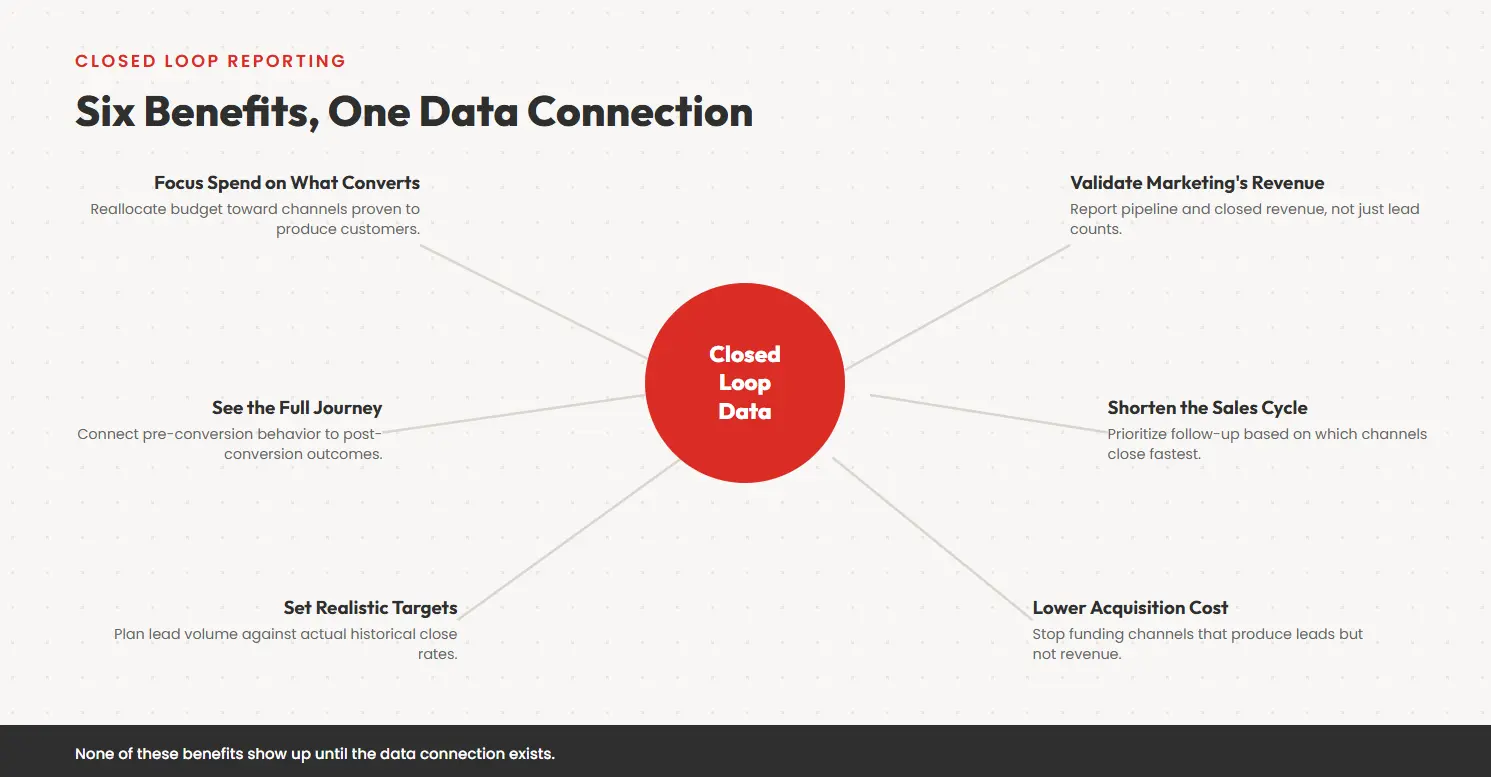
Sharper budget calls, provable ROI, a fuller picture of the customer journey, faster sales cycles, realistic targets, lower acquisition cost. None of these show up until the data connection exists.
Focus Spend on What Actually Converts
When you know which channels generate paying customers instead of just form fills, reallocating budget gets easy. If paid search converts at twice the rate of social ads, that’s where the next dollar goes.
Lead-to-customer conversion rates vary heavily by industry and channel, which is exactly why blended averages mislead you. A channel converting at 2% needs a completely different lead volume target than one converting at 15%, and you only know which is which once revenue gets tied back to source.
Validate Marketing’s Contribution to Revenue
Closed loop data gives marketing a seat at the revenue table instead of a seat at the lead-volume table. Instead of saying “we generated 500 leads,” marketing can say “we generated $1.2 million in pipeline and $380,000 in closed revenue.” That second sentence gets budget approved. The first one gets questioned.
This matters most when marketing initiatives are competing for the same finite budget. A campaign that produces vanity leads will always look weaker next to one with revenue attached, once leadership can actually see both numbers side by side.
See the Entire Customer Journey
Closed loop reporting connects pre-conversion behavior, pages visited, time on site, number of visits, to post-conversion outcomes. That combination shows you what your best customers actually looked like before they ever became leads, across the entire customer journey rather than just the moment they converted. Getting that full picture usually requires full-funnel attribution, since any single touchpoint only tells part of the story.
Shorten the Sales Cycle
When sales reps know which content and channels correlate with faster-closing deals, they can prioritize follow-up accordingly. A lead from a high-intent channel deserves faster, more aggressive follow-up than one from a low-intent channel.
Set Realistic Targets by Channel
Once you know historical lead-to-customer ratios per channel, you can set targets that reflect reality instead of hope. A channel converting 2% of leads needs a very different volume target than one converting at 15%.
Lower Blended Customer Acquisition Cost
HubSpot’s State of Marketing research shows organizations that align sales and marketing around shared revenue data report stronger marketing ROI than those tracking lead metrics alone. When you stop spending on channels that generate leads but not revenue, your overall cost per customer drops, even if total budget stays flat.
Closed Loop Reporting vs. Standard Marketing Attribution
Closed loop reporting connects a lead source to a revenue outcome. Attribution then decides how to split credit for that outcome across multiple touchpoints. People use the terms interchangeably, but they’re not solving the same problem.
| Concept | What It Measures | Primary Use |
|---|---|---|
| Closed loop reporting | Whether a lead source eventually produced revenue | Connecting marketing to sales outcomes |
| Marketing attribution | How credit for a conversion splits across touchpoints | Optimizing channel and campaign mix |
| Lead scoring | How likely a lead is to convert based on behavior | Prioritizing sales follow-up |
Closed loop reporting is the foundation. You need the marketing-to-sales data connection in place before any attribution model, first-click, last-click, linear, or data-driven, can produce trustworthy numbers. Without closed loop data, attribution models are working with incomplete inputs, no matter how sophisticated the model is.
How to Implement Closed Loop Reporting
None of this requires a developer. It requires someone willing to actually look at what’s in the source field on your CRM records right now.
Audit Your Current Tracking Gaps
Start by checking whether your CRM leads currently show any traffic source data at all. If most leads show “(not set)” or blank source fields, that’s the gap closed loop reporting needs to fix first. This single check usually reveals the scale of the problem faster than any dashboard review.
Connect Analytics Data to Your CRM
This is the technical core of the whole process. You need a tool that captures visitor-level source data and writes it to the lead record at the moment of conversion, not after the fact. GA Connector does this by attaching first-click, last-click, and full multi-touch path data to each new lead the moment it’s created, whether your CRM is Salesforce, HubSpot, Pipedrive, or Zoho.
Send Deal Outcomes Back to Your Analytics Platform
The loop isn’t fully closed until revenue flows the other direction too. GA Connector pushes closed-won deal data from your CRM back into GA4, using the visitor’s Google Analytics Client ID as the matching key. That means you can analyze CRM revenue using any GA4 attribution model, not just last-click, even on sales cycles that stretch past 12 months.
Build Your First Closed Loop Report
Start simple. One report, run quarterly, answers a single question: which channels and campaigns produced the most closed-won revenue last quarter? That one report alone often surfaces enough insight to justify a full budget reshuffle of your marketing efforts.
Train Sales and Marketing to Use the Same Numbers
Closed loop reporting only works if both teams trust the same dashboard. Get marketing and sales leadership looking at the same revenue-by-source report in the same meeting, not two different versions pulled from two different tools.
Common Challenges in Closed Loop Reporting
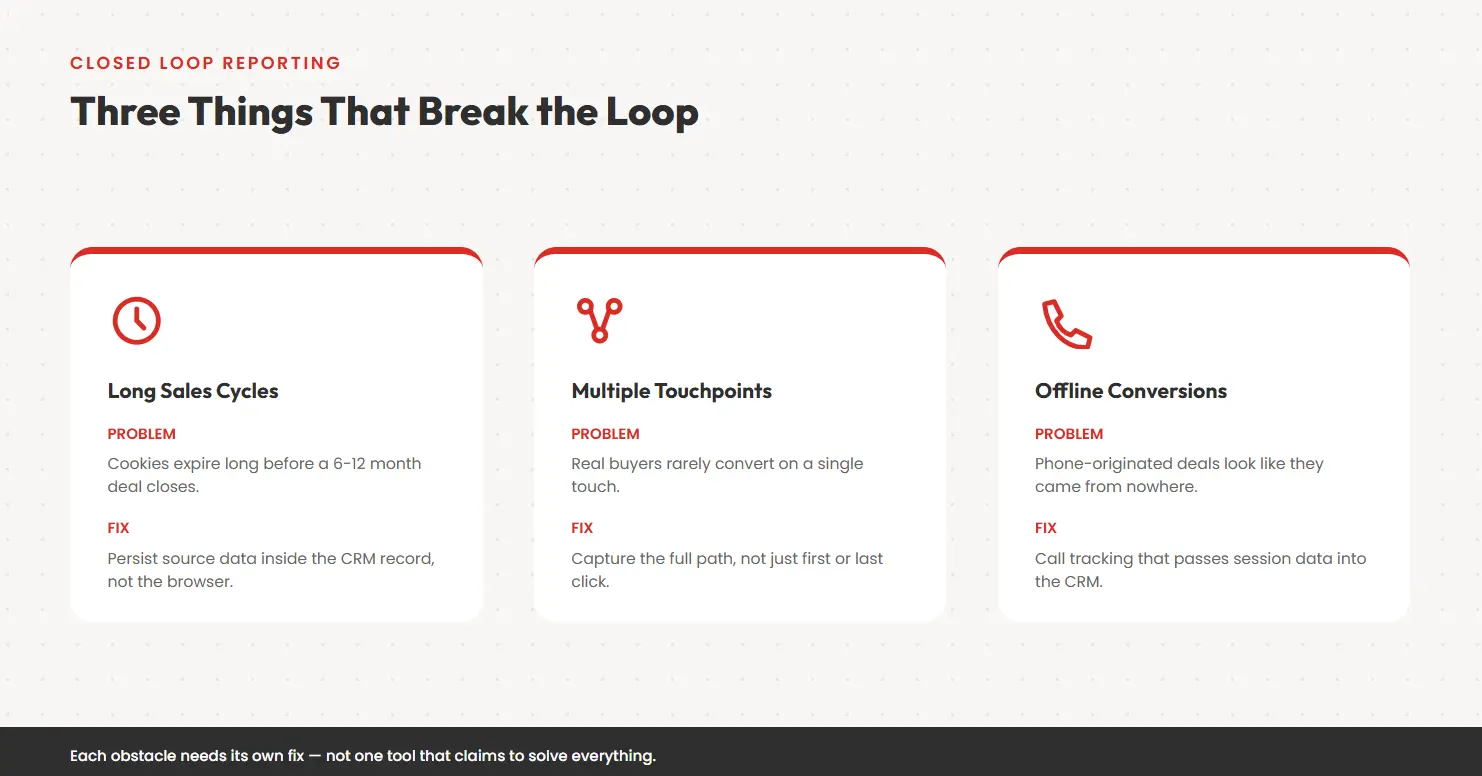
Long sales cycles, multi-touch journeys, and offline conversions break closed loop tracking in three different ways. Each one needs its own fix, not a single tool that claims to solve everything.
Long Sales Cycles Break Simple Tracking
A 12-month enterprise sales cycle means the original click happened a year before the deal closes. Cookies expire. Sessions get lost. B2B sales cycles average well over two months across most industries, and complex or enterprise deals routinely stretch past a year, long enough for cookie-based tracking alone to fail. Tools built for closed loop reporting need to persist source data inside the CRM record itself, independent of cookie lifespan.
Multiple Touchpoints Complicate “the” Source
Real buyers rarely convert on a single touch. They see an ad, forget about it, search your brand name two weeks later, then convert from an email three weeks after that. Good closed loop reporting captures the full path, not just first or last click, so you’re not forced to pick a single winner arbitrarily.
Offline and Phone Conversions Get Missed
Plenty of deals start online and close over a phone call. If your tracking only covers form submissions, every phone-originated deal looks like it came from nowhere. Call tracking integrations that pass session data into the CRM solve this gap, and they matter more than most teams assume given how many B2B deals still close by phone after an initial digital touch.
How GA Connector Can Help
Here’s how you can implement closed loop reporting using GA Connector:
- Sign-up for a FREE 30-day commitment-free trial.
- Next, begin the setup process by selecting your chosen CRM and following the provided steps.
- Build powerful closed loop reports with comprehensive data on your leads and customers.’
Once you have completed these three easy steps, you will have access to comprehensive insights about your marketing ROI in your CRM. From there, you will be able to see exactly how effective each marketing channel is and make decisions about which channels to pursue.
Get started now and create powerful closed loop reports when you sign up for a free trial at GAConnector.com.
Frequently Asked Questions
What is closed loop reporting in marketing?
Closed loop reporting is the process of connecting marketing data, like traffic source and campaign, to the sales outcomes those leads eventually produce. It lets marketing teams see which channels generate revenue, not just leads, by tracking a lead from first visit through closed deal.
How is closed loop reporting different from attribution?
Closed loop reporting is the data connection between marketing sources and sales outcomes. Attribution is the model used to assign credit across multiple touchpoints once that connection exists. You need closed loop data first before attribution modeling can produce reliable results.
What tools do I need for closed loop reporting?
You need a way to capture visitor-level traffic source data and attach it to CRM lead records, plus a way to send closed deal data back to your analytics platform. Tools like GA Connector handle both directions for CRMs including Salesforce, HubSpot, Pipedrive, and Zoho.
Does closed loop reporting work for long B2B sales cycles?
Yes, as long as the tracking tool stores source data inside the CRM record rather than relying on browser cookies alone. Cookies can expire well before a 6 to 12 month sales cycle closes, so persistent CRM-based storage is essential for long-cycle businesses.
Can closed loop reporting track phone or offline conversions?
Yes, when paired with call tracking software that passes session and source data into the CRM at the time of the call. Without that integration, phone-originated leads typically show up with no source data at all.

Sergii Zuiev is the founder of GA Connector, a marketing attribution platform helping sales and marketing teams track revenue back to the channel, campaign, and keyword level. With a background in PPC and marketing technology, he built GA Connector in 2015 after experiencing firsthand the frustration of not knowing which ads actually drove revenue, and turned that insight into a product now used by hundreds of companies globally.


