Your Zapier bill jumped from $49 to $289 last quarter. You didn’t add 500 workflows – you added one. That’s the math every growing team runs the moment per-task pricing meets multi-step automations at scale – and why almost everyone starts comparing the best Zapier alternatives and marketing automation tools for their CRM workflows.
Here’s the good news: the Zapier alternatives are mature, the pricing-at-scale math is favorable, and most marketing and CRM workflows port cleanly to Make or Pabbly Connect within a weekend. Here’s the bad news: a few specific use cases – attribution stitching, real-time deal-stage events to ad platforms, self-hosted CRM data – need something more specialized than a like-for-like Zapier swap.
This guide separates the two. We’ll compare 11 Zapier alternatives for marketing and CRM workflows, broken down by pricing model (per-operation, per-execution, flat-rate, enterprise), the specific use cases each one wins, the pricing-at-scale math at real lead volumes, and a decision matrix that maps your exact Zapier complaint to the right replacement.
The 11 best Zapier alternatives for marketing and CRM workflows (at a glance)
Below is the full comparison – screenshot the row that matches your situation. A few notes first.
Most “top 10 Zapier alternatives” lists rank the most popular automation tools in the same order regardless of what you’re automating. Our top Zapier alternatives comparison is anchored in marketing and CRM work, so the picks follow from the job, not brand recognition.
Pricing models matter more than headline prices
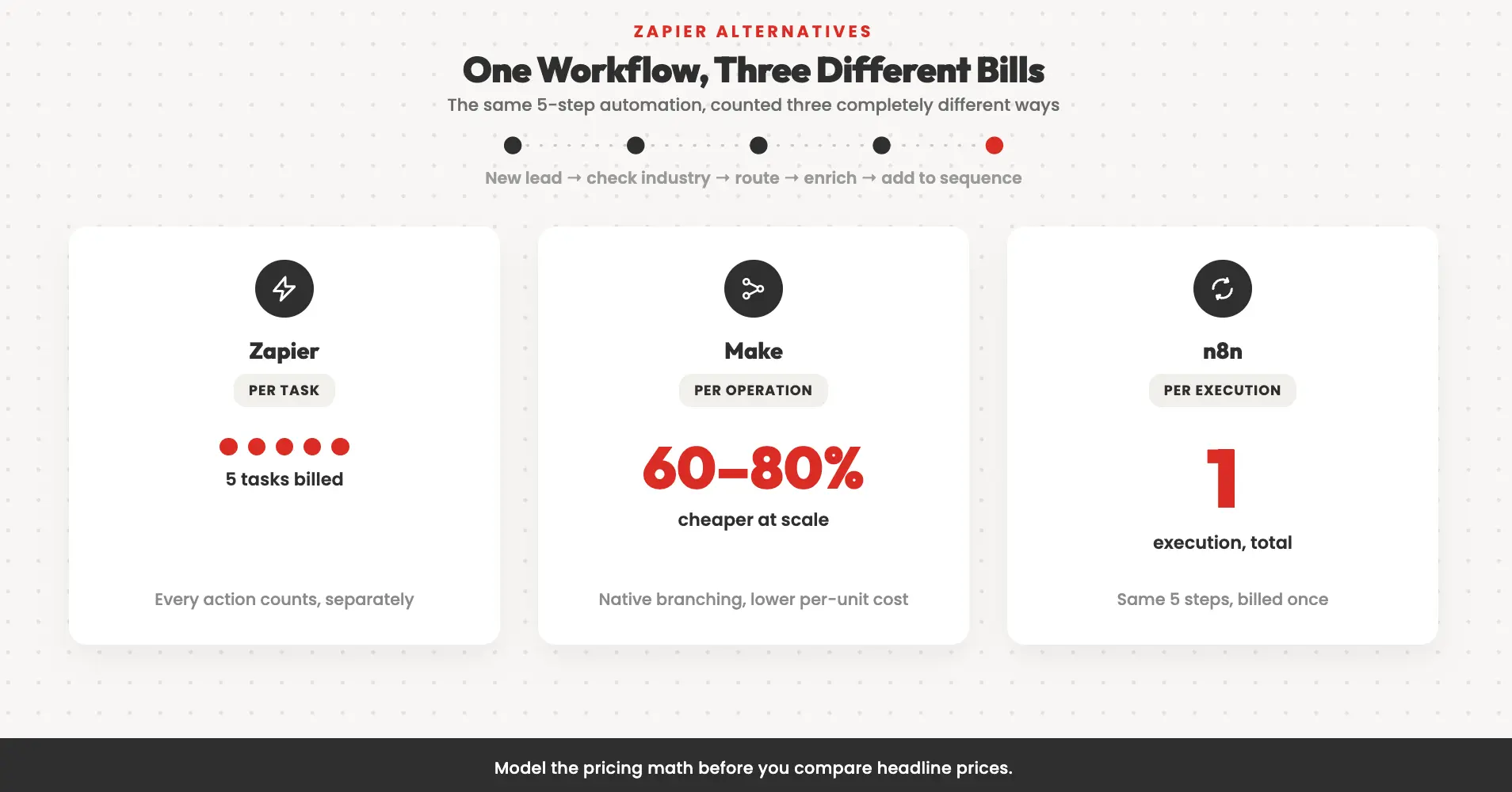
Zapier charges per task (one successful action). Make charges per operation. n8n charges per execution – one full workflow run, regardless of steps. Pabbly Connect is flat-rate. Power Automate is per user or per flow. Workato and Tray.ai use enterprise per-recipe or per-workflow models. These distinctions matter most to non technical users and decide your bill at scale.
Integration breadth is Zapier’s moat
Most of these automation tools cover the mainstream marketing and CRM stack – HubSpot, Salesforce, Pipedrive, Google Ads, Meta, Slack. All prices below are current published rates as of 2026 and change often; where a vendor gates pricing behind sales, we’ve said so.
| Tool | Pricing model | Starting price | Best for (marketing/CRM use case) | Main trade-off vs Zapier |
|---|---|---|---|---|
| Zapier (for reference) | Per task | $29.99/mo (750 tasks) | Broadest app coverage for SMBs | – |
| GA Connector (purpose-built) | Flat / usage-based subscription | From ~$97/mo | CRM ↔ GA4 attribution: source on every lead, revenue back to GA4 | Single-purpose tool, not a general automation platform |
| Make (formerly Integromat) | Per operation (“credits”) | $9/mo (10,000 ops, annual) | Multi-branch CRM workflows with conditional logic | Steeper learning curve, but ~60–80% cheaper at scale |
| n8n | Per execution (cloud) or free self-hosted | €20/mo cloud; free self-hosted | Self-hosting, GDPR-controlled data, or AI workflows | Requires technical setup; ~400–500 native integrations |
| Pabbly Connect | Flat-rate (only actions count) | ~$19/mo, unlimited workflows | High-volume simple automations (lead routing, list sync) | Smaller integration library; less polished UI |
| Microsoft Power Automate | Per user / per flow | Bundled with M365 or $15/user/mo | Teams deep in Microsoft 365 | Great inside Microsoft; awkward and pricey outside it |
| Workato | Per recipe (enterprise) | Custom; ~$10,000+/yr (sales-gated) | Enterprise RevOps on Salesforce, SAP, NetSuite | Enterprise pricing; overkill for SMBs |
| Activepieces | Flat-rate or free open source | Free self-host; $0 cloud free tier | Open-source teams on a mainstream CRM stack | ~400+ integrations vs Zapier’s 9,000+ |
| LeadsBridge | Per lead / per bridge | ~$22/mo starter | Ad platforms (Meta, LinkedIn) to CRMs | Narrow scope – mostly ad-platform ↔ CRM lead sync |
| Tray.ai (Tray.io) | Per task / workflow (enterprise) | Custom; Pro ~$595/mo (sales-gated) | Mid-market–enterprise ops with engineers | Enterprise pricing and a learning curve |
| Relay.app | Per step, human-in-the-loop | ~$19/mo (single user) | AI-assisted automations with approval steps | Smaller integration count (~100+); newer platform |
| IFTTT | Flat-rate, simple flows only | ~$2.99/mo Pro | Personal/social-media triggers; not CRM ops | No branching or multi-step CRM logic |
The 11 Zapier alternatives, in detail
Here’s each option in depth, with the marketing or CRM use case it actually wins, current pricing, and an honest read on where Zapier still beats it.
GA Connector (the CRM ↔ GA4 attribution specialist)
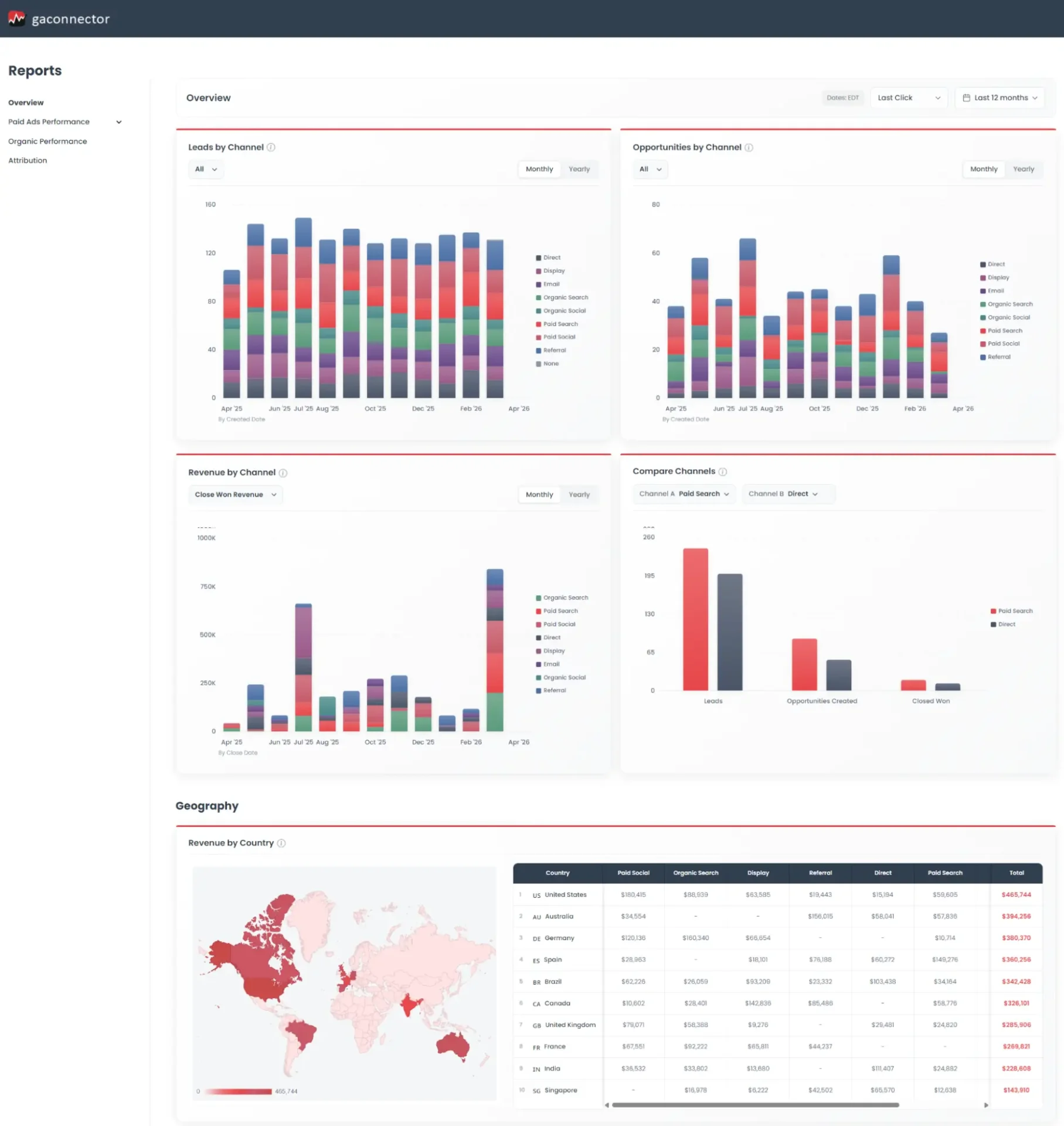
GA Connector is not a general-purpose Zapier alternative. It doesn’t do 9,000 app integrations or generic trigger-action workflows. It’s a purpose-built CRM ↔ GA4 integration that exists for one use case where general automation tools genuinely struggle.
For most marketing and CRM workflows, Make, Pabbly Connect, or n8n is the right Zapier replacement. But keeping the GA4 Client ID stitched through Lead → Contact → Opportunity – and sending closed-won revenue back to GA4 via the Measurement Protocol – is where Zapier is not working. Zaps don’t natively understand Client ID, Session ID, or event deduplication, and every lead can burn 5–10 tasks.
GA Connector captures source, campaign, and Client ID on every lead, writes it to Salesforce, HubSpot, Pipedrive, or Zoho, persists it through conversion, and sends revenue back to GA4 – and keeps working through CRM and GA4 changes. Pricing is tiered and usage-based, starting around $97/month with a free trial. See the full setup in the marketing attribution in Salesforce guide.
If your specific pain is CRM ↔ GA4 attribution that keeps breaking on Zaps, see how GA Connector handles the Client ID stitching automation platforms can’t – start a free trial.
Who should choose this
Teams whose CRM ↔ GA4 attribution keeps breaking on general-purpose Zaps.
Make (formerly Integromat)
What it is
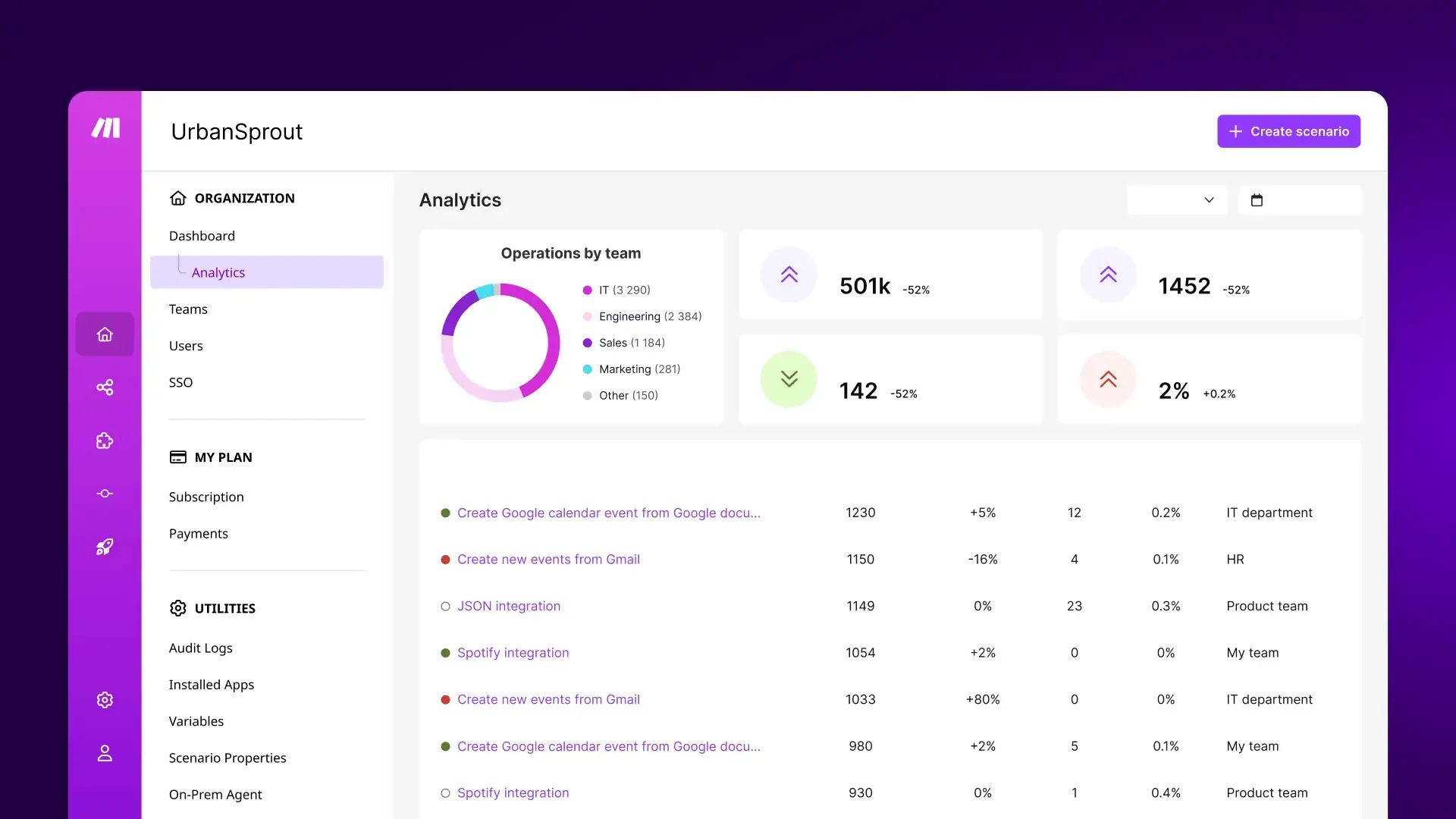
Make is a visual workflow automation platform built around a drag and drop canvas. It’s the most common upgrade for teams that have outgrown Zapier on cost and complexity, Pricing is per operation, now metered in credits – Make switched from “operations” to “credits” in August 2025.
Best for
Multi-branch CRM workflows with conditional logic and data transformation. Example: new lead → if industry = finance, route to the enterprise SDR queue, fire the LinkedIn Insight Tag, and add to Sequence A; else route to the SMB queue and add to Sequence B. That branching logic and custom logic is native on Make’s visual workflow builder; on Zapier it’s awkward.
Pricing
A free plan covers 1,000 credits a month. Core starts at $9/month (billed annually) for 10,000 operations, Pro at $16/month, and Teams at $29/month; advanced features like priority execution sit on the higher tiers. Monthly billing runs higher, and AI steps plus extra credit packs cost more.
Trade-offs vs Zapier
Make is roughly 60–80% cheaper at comparable volume and far stronger at complex workflows and custom workflows. The cost is a steeper learning curve – the visual interface rewards the time you invest, and there’s more of a learning curve than Zapier’s linear editor.
Who should choose this
Marketing and RevOps teams that want Zapier’s breadth at a fraction of the price and don’t mind a short ramp. (For the full head-to-head, see our Zapier vs Make deep-dive.)
n8n
What it is
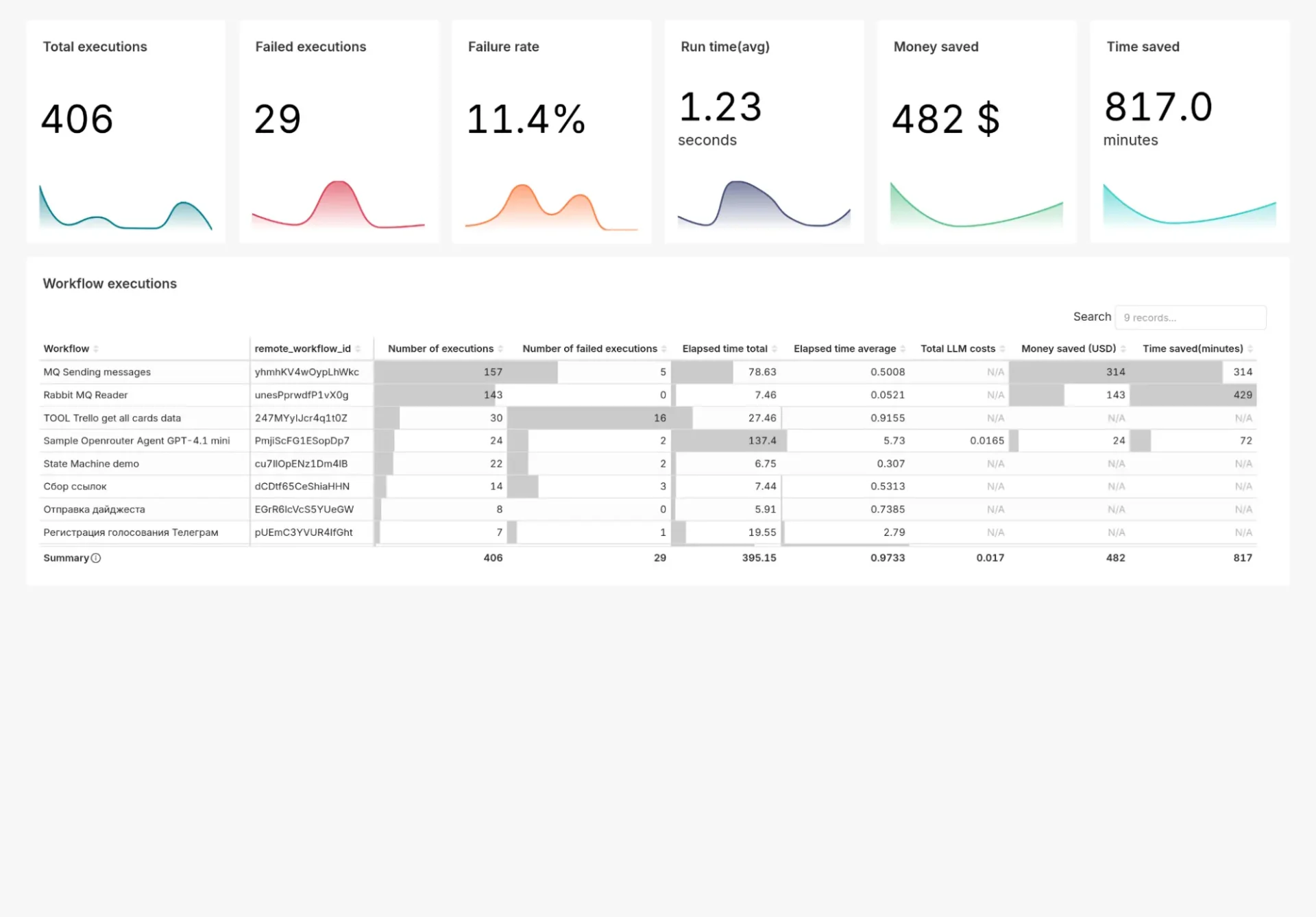
n8n is a source-available workflow automation tool with a node-based, drag and drop builder and a genuine self host story. It bills per execution – one full workflow run counts as a single execution no matter how many steps it contains, which makes complex workflows and multi step workflows dramatically cheaper than per-task pricing.
Best for
Technical teams that need to self host, keep sensitive data in house for GDPR or HIPAA, or build advanced workflows, custom workflows, and AI workflows with native LLM nodes and AI agents. It’s also a favorite for internal tools where you control the infrastructure.
Pricing
The self-hosted Community Edition is free and runs unlimited automation – you pay only for the server (roughly $5–50/month). n8n Cloud starts at €20/month (about $24) for 2,500 executions on Starter and €50/month for 10,000 on Pro, with custom pricing on Enterprise. There’s no permanent free cloud tier; the model is execution-based.
Trade-offs vs Zapier
n8n wins on per-execution pricing, code-level custom logic, and data residency. Zapier wins on native integration count (n8n has roughly 400–500) and zero technical setup – running n8n yourself assumes real technical knowledge.
Who should choose this
Engineering-backed technical teams that want unlimited automation on infrastructure they control and don’t mind the technical skills required to self host.
Pabbly Connect
What it is
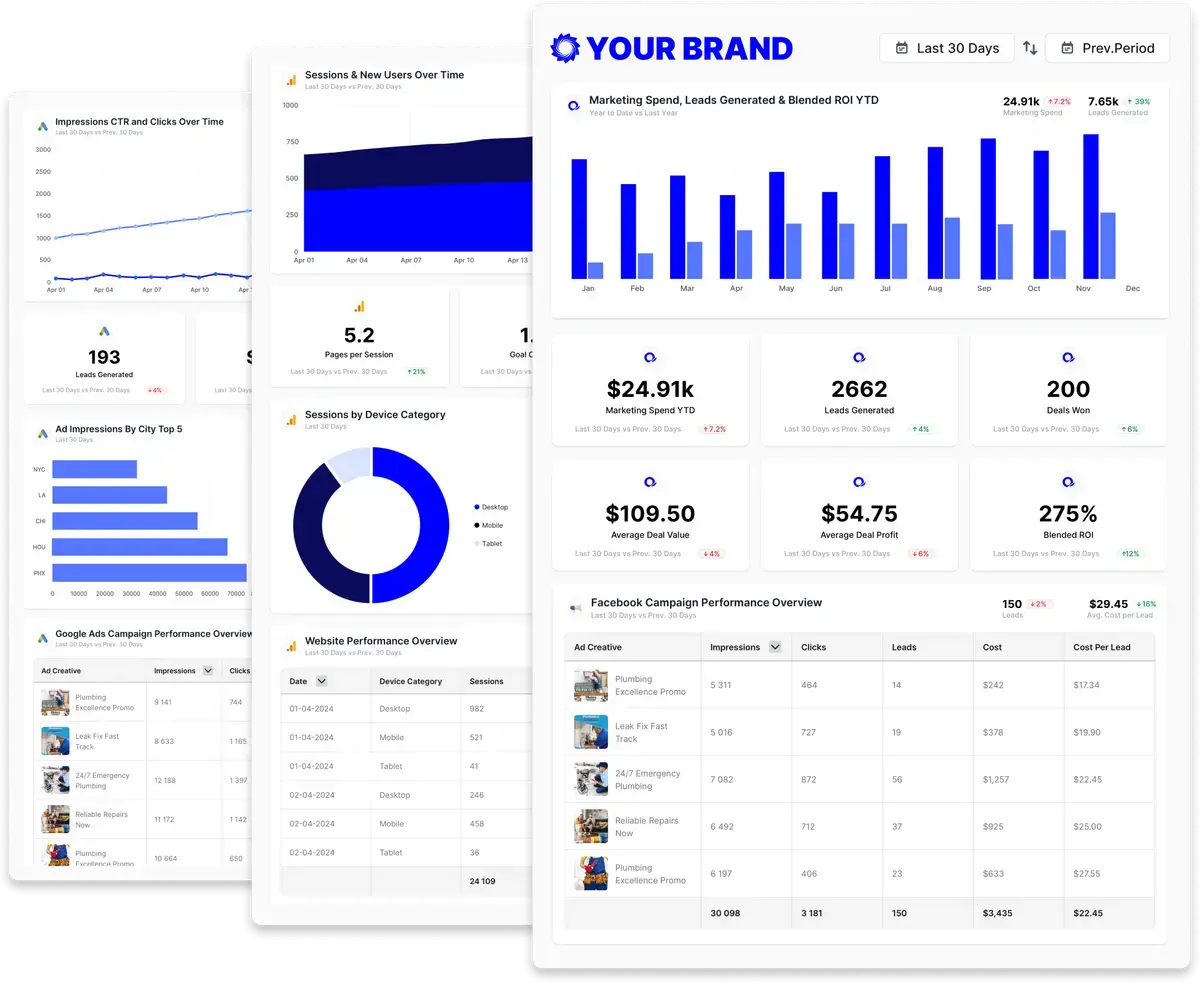
Pabbly Connect is a flat-rate workflow automation platform with a drag and drop editor. Its defining feature: only action steps count toward your task limit – filters, routers, and formatters are free internal tasks. That single decision changes the economics compared to Zapier, especially for small businesses watching every dollar.
Best for
High-volume but relatively simple marketing automations – lead routing, list sync, CRM updates – where you want to automate repetitive tasks at predictable cost with unlimited workflows.
Pricing
A free plan includes 100 tasks a month. Paid plans start around $19/month (billed annually) with unlimited workflows and unlimited team members; higher tiers scale the task count and advanced features. Pabbly also sells one-time lifetime deals from about $249, a rarity in this category. Note that Pabbly Connect’s pricing model has shifted several times – check the current page before you buy.
Trade-offs vs Zapier
Pabbly is dramatically cheaper at volume and doesn’t charge for internal steps, so the same routine tasks cost a fraction as much. Zapier has a larger, more polished integration library and faster customer support.
Who should choose this
Cost-sensitive small businesses running steady, mostly linear automated workflows at scale.
Microsoft Power Automate
What it is
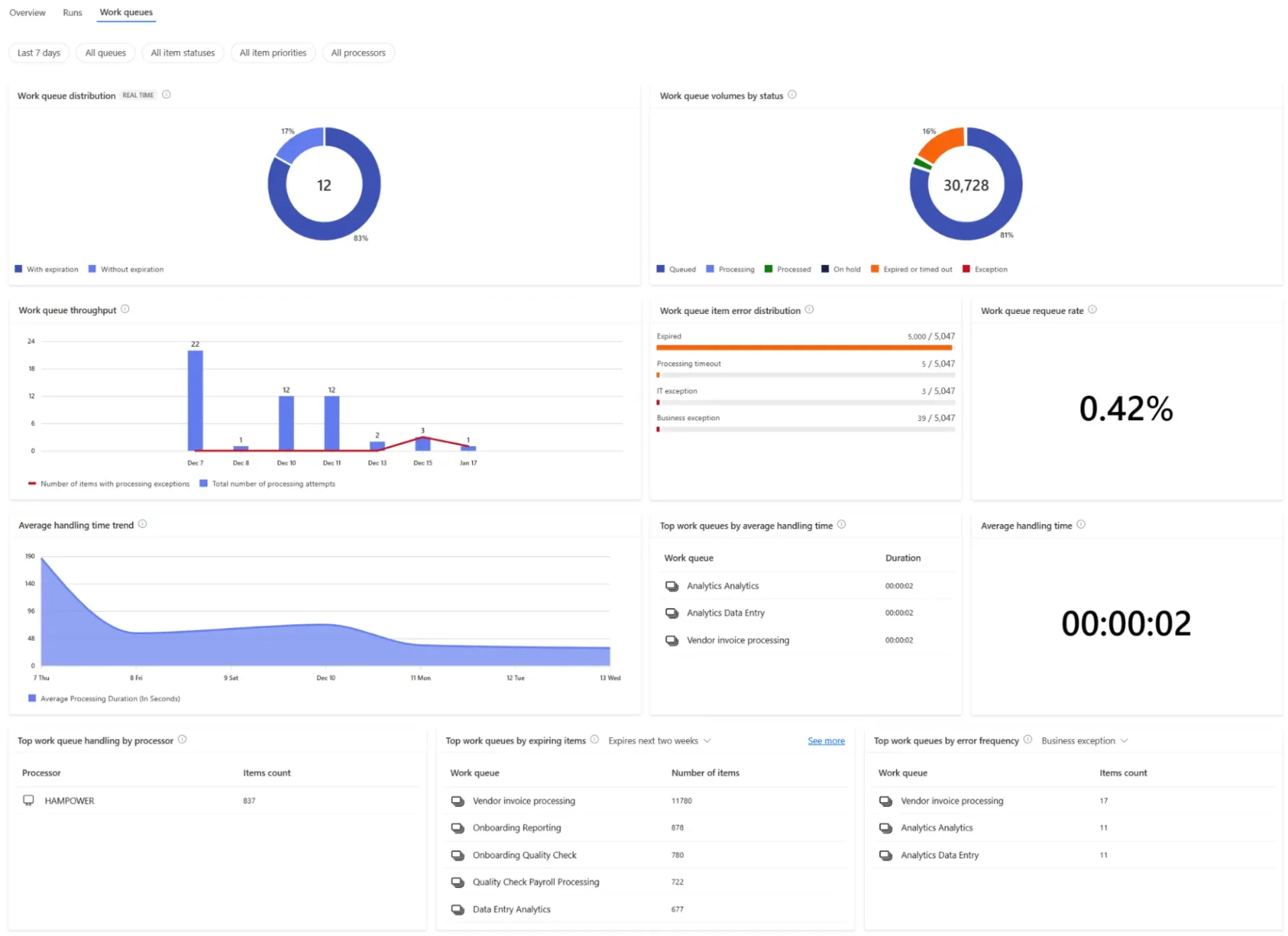
Microsoft Power Automate is Microsoft’s workflow automation platform, spanning cloud flows, a drag and drop designer, desktop flows, and robotic process automation. If your stack already lives in Microsoft 365, some business process automation is bundled into your existing license.
Best for
Marketing and ops teams deep in the Microsoft ecosystem – Dynamics 365, Outlook, Teams, SharePoint – where native integration is tight and free for standard connectors. Microsoft Power is hard to beat when you connect apps across the Microsoft cloud apps you already run.
Pricing
Basic automation on standard connectors comes bundled with eligible Microsoft 365 plans. The moment you need premium connectors (Salesforce, SAP) or attended automation, Power Automate Premium is $15/user/month (billed annually). Unattended robotic process automation runs $150 per bot per month, Microsoft-hosted bots $215 per bot per month, and large rollouts move to custom pricing.
Trade-offs vs Zapier
Microsoft Power Automate is unbeatable value inside Microsoft and bundles RPA that Zapier doesn’t offer. Outside the Microsoft bubble, per-user licensing compounds and premium connectors get expensive fast.
Who should choose this
Microsoft 365 shops automating mostly Microsoft-native business processes and complex business processes across Office apps.
Workato
What it is
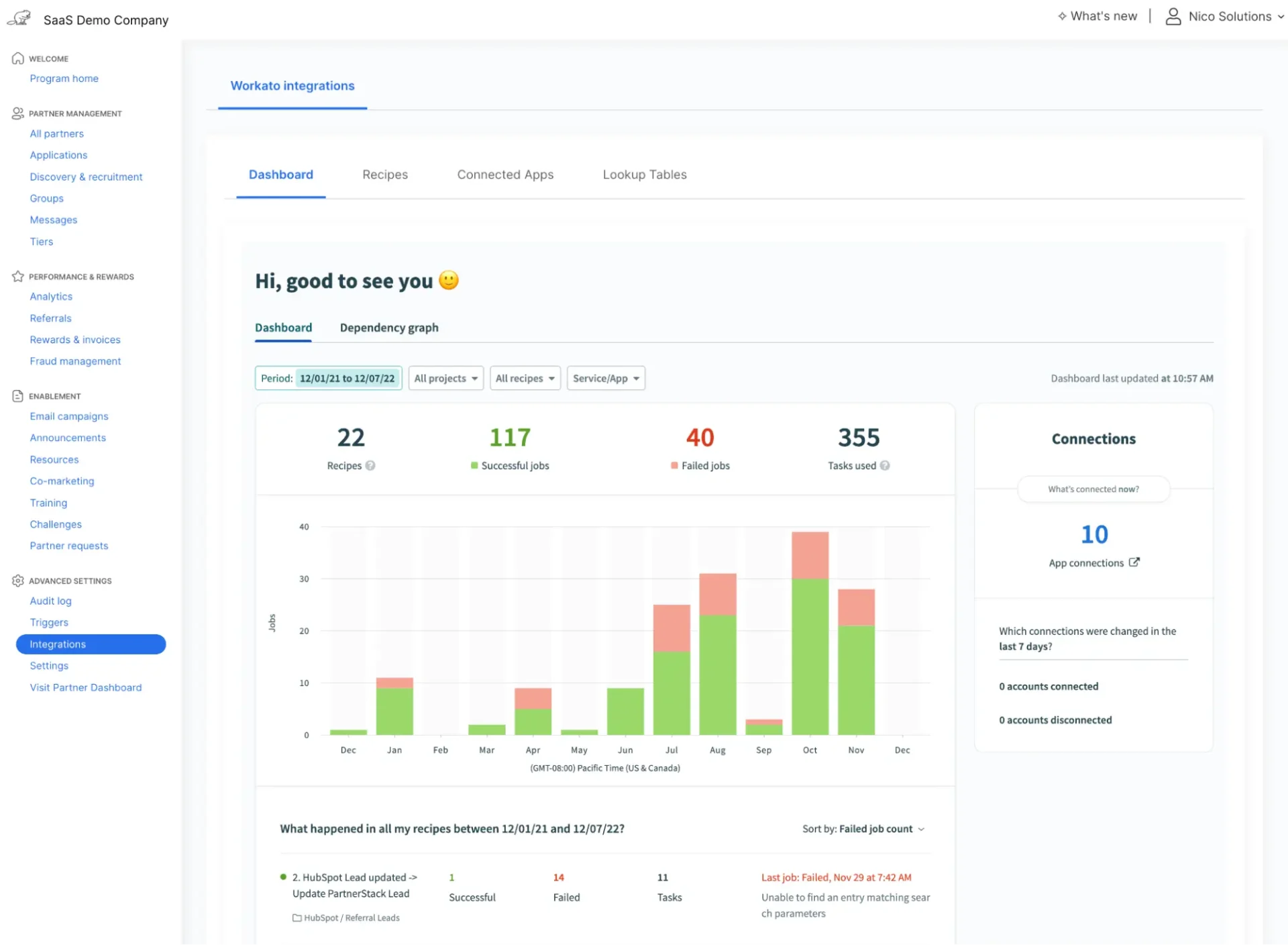
Workato is an enterprise integration platform (iPaaS) built around “recipes” – automated workflows with conditional logic, API management, and deep governance, assembled in a drag and drop builder. It’s the enterprise path, not an SMB Zapier swap.
Best for
Enterprise RevOps connecting Salesforce, SAP, NetSuite, and Workday across complex business processes at scale, with role-based access, audit trails, and a named customer success manager.
Pricing
Custom pricing, sales-gated – there’s no public list price. Disclosed contracts typically start around $10,000/year, with mid-market deployments commonly $25,000–80,000/year and enterprise reaching six figures. Workato holds a 4.7 G2 rating across 700+ reviews, signal that justifies the custom pricing for the right buyer.
Trade-offs vs Zapier
Workato handles complex business processes and governance that lighter automation tools can’t. It’s overkill – and overpriced – for SMBs with simple app-to-app needs.
Who should choose this
Large organizations where automation is a strategic, cross-functional capability with dedicated platform teams.
Activepieces
What it is
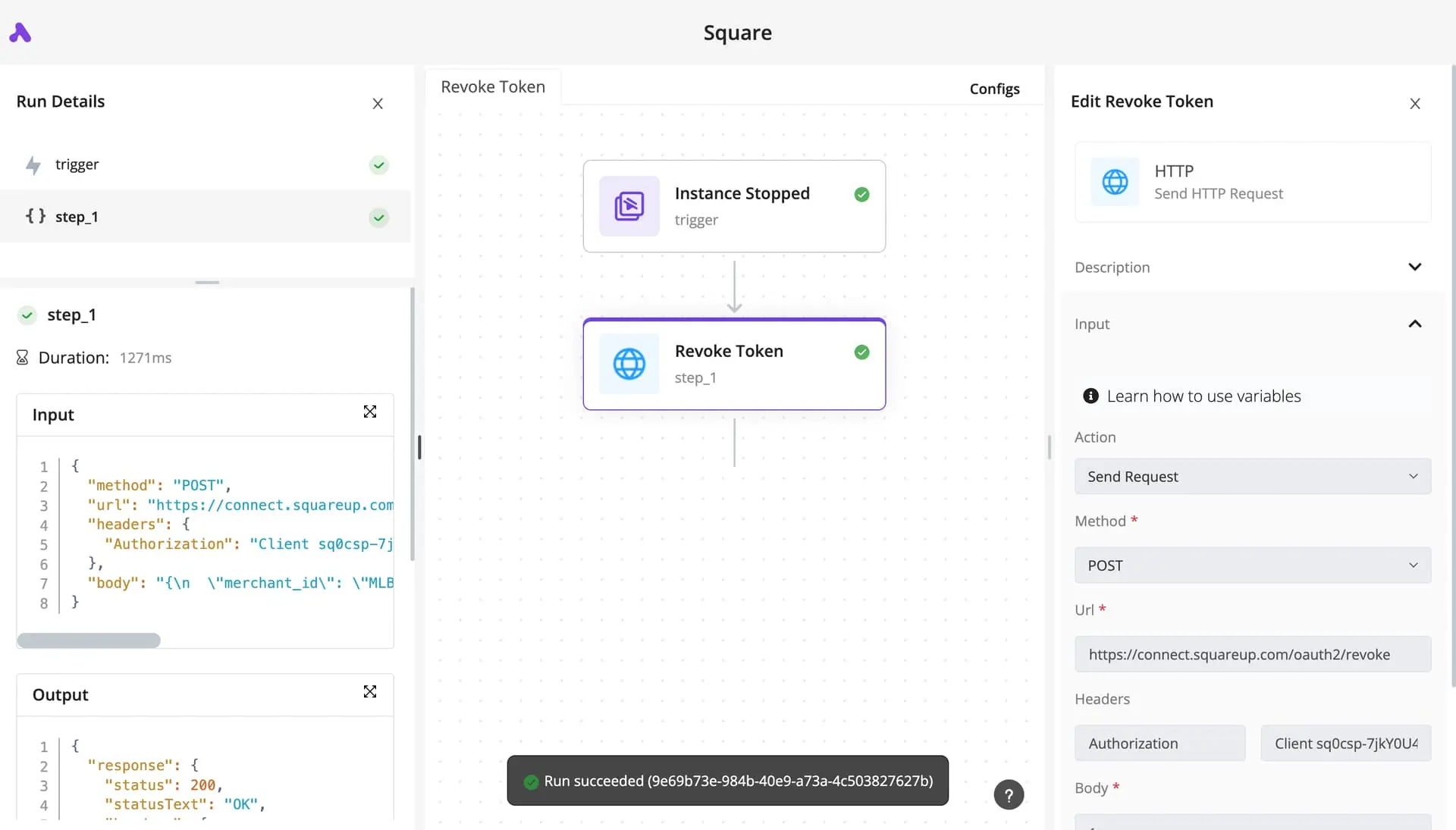
Activepieces is an open source, no code platform (MIT-licensed) with a drag and drop workflow builder you can self host for free or run in the cloud. It’s the option for teams that want data ownership without n8n’s infrastructure complexity – a no code platform you fully control.
Best for
Open-source-preferring marketing teams on a mainstream CRM stack, and compliance-sensitive teams that need custom workflows, automation logic, and sensitive data on their own infrastructure. It’s a strong fit for internal tools that connect apps inside the firewall as well as customer-facing flows.
Pricing
Self-hosting is free with unlimited tasks. The cloud free plan includes 1,000 tasks a month; the Plus plan is $25/month with unlimited tasks and AI agents; Business is $150/month, and Enterprise uses custom pricing.
Trade-offs vs Zapier
Activepieces wins on the ability to self host, transparent pricing, and unlimited cloud tasks on paid plans. It has roughly 400+ integrations versus Zapier’s 9,000+, so niche apps may be missing.
Who should choose this
Budget- or compliance-driven teams comfortable with an open-source tool and a mainstream app stack.
LeadsBridge
What it is
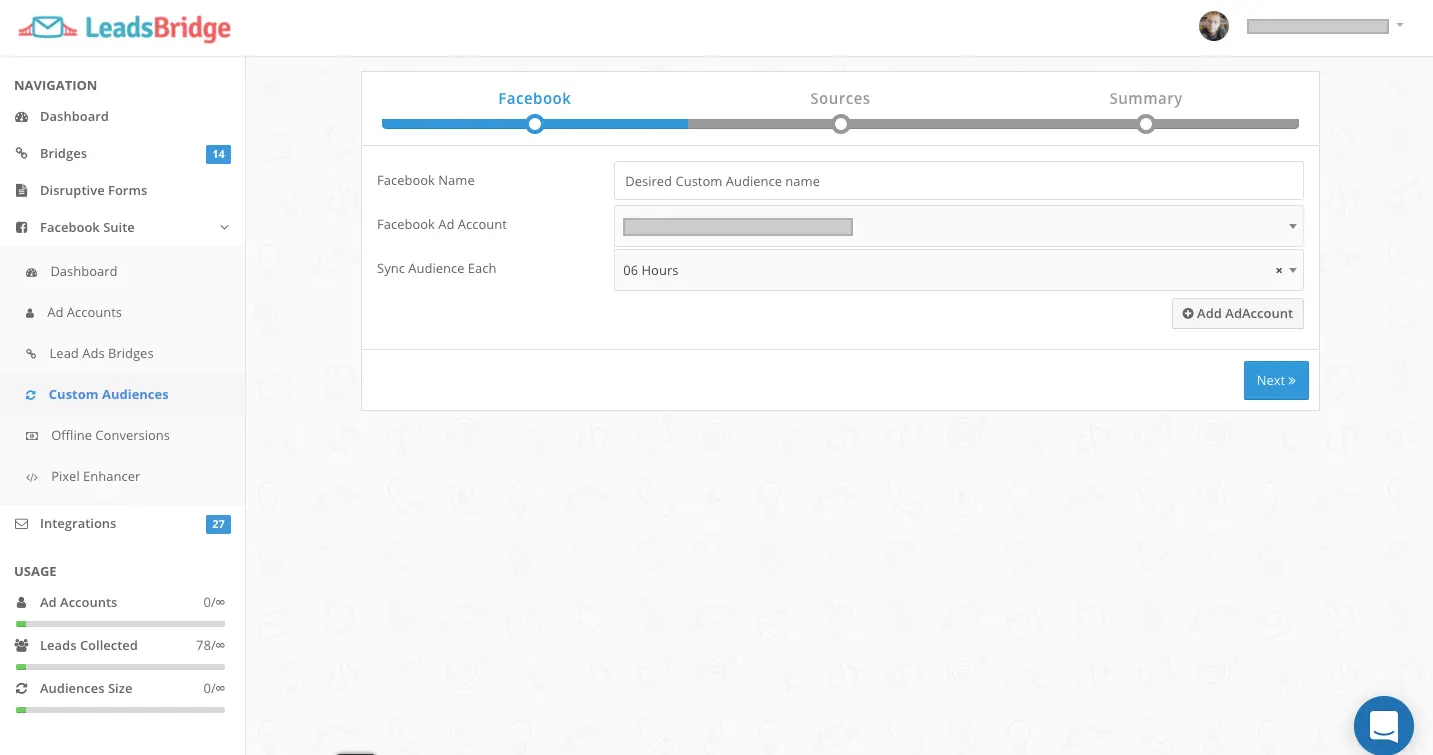
LeadsBridge (owned by ActiveProspect) is a purpose-built bridge between ad platforms and CRMs. It’s narrower than a general automation builder, and that’s the point.
Best for
B2B marketers syncing Meta Lead Ads, LinkedIn, Google Lead Form Ads, and TikTok leads into a CRM in real time – and sending offline conversions back to those platforms via the Conversions API to sharpen customer engagement and retargeting.
Pricing
A free plan covers 50 leads a month and one bridge. Paid plans scale by lead volume and the number of live bridges, starting around $22/month (billed annually); the Business tier adds a dedicated customer success manager and custom integrations and runs $999/month.
Trade-offs vs Zapier
LeadsBridge is built specifically around how ad platforms work – audience sync, lead ads, Conversions API. Its scope is narrow, and a general tool like Zapier or Make can cover the same lead sync, often cheaper.
Who should choose this
Paid-media teams whose core daily workflow is ad-platform → CRM lead sync.
Tray.ai (Tray.io)
What it is
Tray.ai is an enterprise iPaaS that has repositioned around AI – AI agents, MCP governance, and a low code workflow builder and drag and drop canvas alongside a code-first option. It targets mid-market and enterprise ops teams with engineering support.
Best for
Marketing and RevOps orgs building advanced workflows and high-volume integrations across Salesforce, HubSpot, NetSuite, and Zendesk, with the budget and skills to maintain them.
Pricing
Custom pricing, sales-gated, with no free tier (a free trial is available). Disclosed pricing puts the Pro tier around $595/month with 25,000 tasks included; Team and Enterprise are custom. It connects 700+ cloud apps.
Trade-offs vs Zapier
Tray offers deeper enterprise connectors, custom workflows, custom logic, and AI orchestration. It carries enterprise pricing and a steeper learning curve than Zapier.
Who should choose this
Mid-market-to-enterprise teams that need power and have engineers to wield it.
Relay.app
What it is
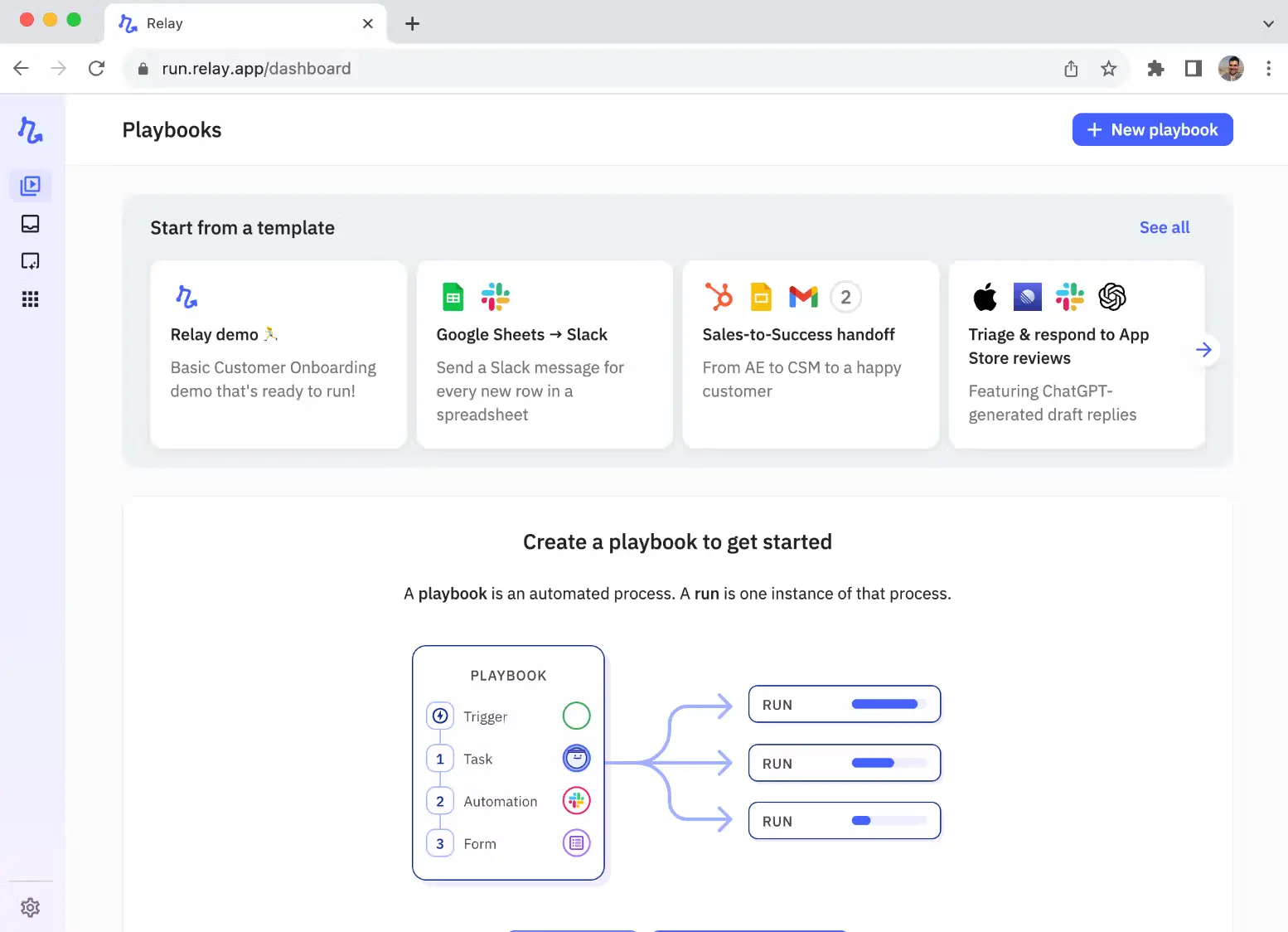
Relay.app is a newer workflow automation platform whose signature feature is human-in-the-loop – workflows pause for human approval, input, or review before continuing. It also leans AI-first, with built-in steps and AI capabilities that call top models through a simple drag and drop builder.
Best for
Marketing teams that want AI-assisted automated workflows with approval gates – content sign-off, expense authorization, anything where a human should check before an action fires. It scales from basic automation up to multi step workflows.
Pricing
A free plan covers light use for a single user. Paid plans start around $19/month (billed annually) for one user and scale to team tiers around $69+/month for up to 10 users, with custom pricing on Enterprise. AI steps draw on monthly credits; pricing has shifted, so confirm current rates.
Trade-offs vs Zapier
Relay’s native pause-and-resume approvals are purpose-built and hard to replicate cleanly elsewhere, and its AI capabilities are first-class. Its integration library is smaller (~100+) and the platform is younger.
Who should choose this
Teams whose automated workflows genuinely need human judgment at specific steps.
IFTTT
What it is
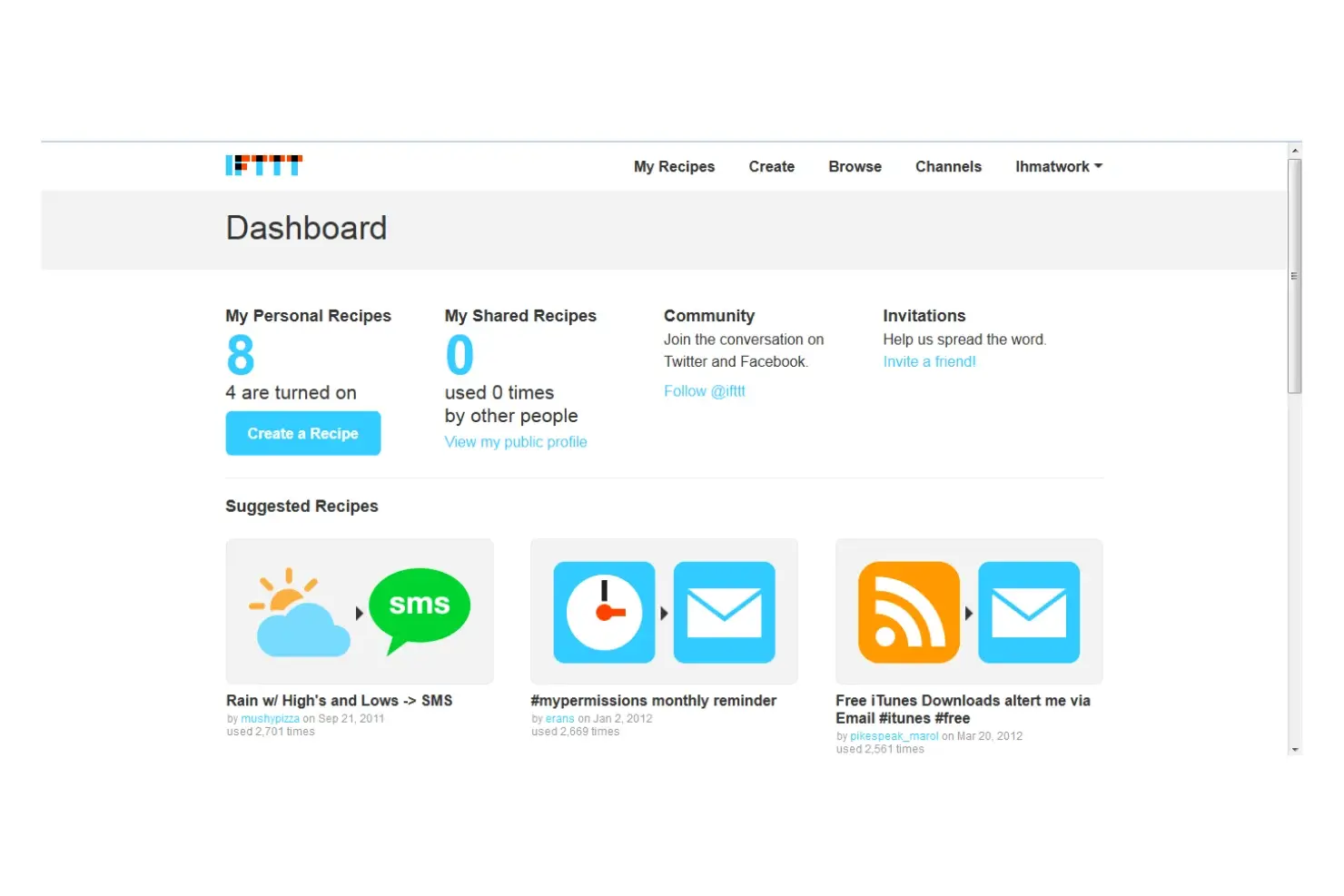
IFTTT (If This Then That) pioneered the simple trigger-action model and remains the cheapest consumer-grade option. It’s built for personal productivity and smart-home automation, not CRM operations.
Best for
Personal marketing tasks and social-media triggers – auto-posting, simple cross-platform alerts – not multi step workflows in a CRM. It’s a quick way to automate tasks between consumer apps and existing tools you already use.
Pricing
A free plan allows 2 applets. Pro is about $2.99/month for 20 applets and multi-action support; Pro+ is about $8.99/month for unlimited applets plus advanced features like filter code and AI services. It connects 700+ services.
Trade-offs vs Zapier
IFTTT is far cheaper and dead simple for basic automation. It has no real branching logic or multi-step CRM logic, which rules it out for serious marketing and CRM work.
Who should choose this
Solo marketers automating simple, personal, social-first routine tasks – not RevOps teams.
Which Zapier alternative should you choose?
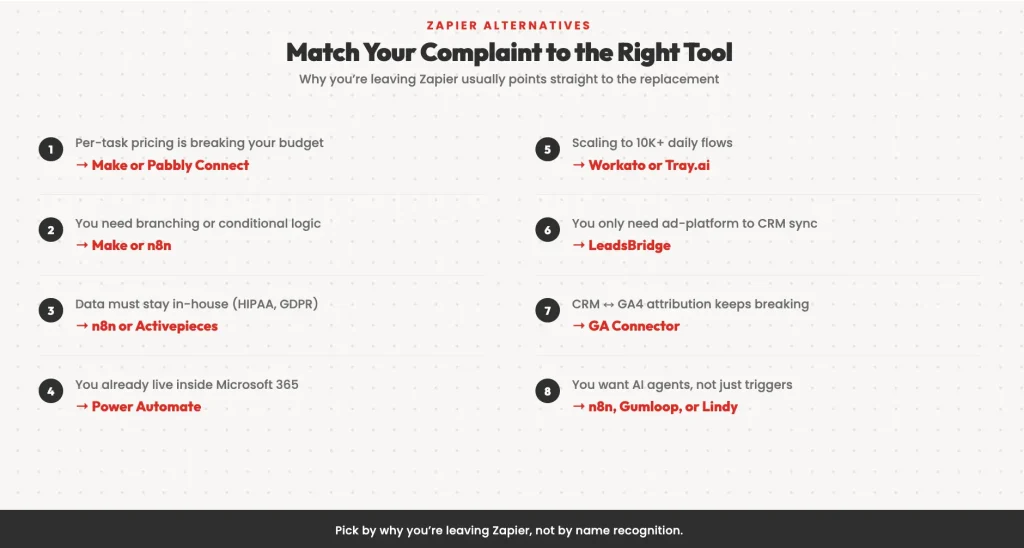
Start with the reason you’re leaving Zapier – that single fact usually points to the right replacement. Match your complaint to the row below.
| If you’re leaving Zapier because… | Pick this | Why |
|---|---|---|
| Per-task pricing is breaking your budget at volume | Make or Pabbly Connect | Both scale cheaper than per-task billing |
| You need conditional / branching logic Zapier struggles with | Make or n8n | Visual canvas builders handle if/then/for-each natively |
| Your CRM data has to stay in-house (HIPAA, GDPR) | n8n or Activepieces (self-hosted) | Both run on infrastructure you control |
| You’re already on Microsoft 365 | Microsoft Power Automate | Bundled into M365; tight Dynamics 365 integration |
| You’re scaling to enterprise (10K+ daily flows) | Workato or Tray.ai | Enterprise iPaaS with SLAs and governance |
| You only need ad-platform → CRM lead sync | LeadsBridge | Purpose-built for Meta, LinkedIn, Google Lead Form Ads → CRM |
| You’re trying to fix CRM ↔ GA4 attribution with Zaps | GA Connector | Purpose-built; Zapier-glue breaks on Client ID stitching |
| You want AI agents, not just trigger-action | n8n, Gumloop, or Lindy | Native LLM / agent nodes for AI workflows |
Two notes on the matrix. First, AI agents is now a real category, not a buzzword – n8n, Gumloop, and Lindy ship native LLM and agent nodes designed for AI workflows, where AI agents reason and act rather than just move data between fields. If you’re evaluating an AI workflow builder, start there, because AI agents can chain decisions across your marketing tools and existing systems. Second, the CRM ↔ GA4 attribution row is narrow on purpose: it’s the one case where a general-purpose integration platform beats a general automation tool, because the Client ID stitching breaks.
Common mistakes when switching from Zapier
Most migrations fail for the same handful of reasons. Avoid these and the switch is usually painless – these Zapier alternatives keep your repetitive tasks running just as reliably as Zapier did.
- Switching tools without re-architecting workflows. Lifting a Zap one-for-one into Make wastes the new pricing model. Rebuild and create workflows around operations or executions, not tasks.
- Underestimating the learning curve of Make. The visual interface is powerful but not instant. Budget a few days to create workflows confidently, not a few minutes – complex tasks take time to get right.
- Picking n8n self-hosted without DevOps support. “Free” software still needs a server, a database, backups, and patching. Without someone to own the technical setup, the savings from choosing to self host evaporate.
- Forgetting governance. As you scale automated workflows across a team, role-based access, audit logs, and version control stop being optional – they’re part of basic data management.
- Using a general-purpose automation tool for CRM ↔ GA4 attribution. The classic one. Zapier-glue and even Make break on Client ID stitching; use a purpose-built tool for that single job.
- Treating per-task and per-operation as equivalent. They aren’t. A five-step workflow is five Zapier tasks but more operations on Make and a single execution on n8n. Compared to Zapier, the same workflow can cost wildly different amounts elsewhere, so model your real volume first.
- Ignoring rate limits and quotas. Every platform throttles. Hit a cloud app’s API limit while syncing across cloud apps and your plan’s cap, and workflows pause – sometimes silently.
- Migrating everything at once. There’s no automated importer between these tools – not even a Google Apps Script shortcut will save you. Move your highest-value workflows first, validate them, then migrate the rest.
Pick by use case, not by name recognition
Zapier alternatives aren’t interchangeable. Make is the cost-and-complexity upgrade. Pabbly Connect is the volume-pricing fix. n8n is the self-hosting answer. Workato and Tray.ai are the enterprise paths. LeadsBridge is the ad-platform lead-sync specialist. GA Connector is the CRM ↔ GA4 attribution specialist. Pick by use case, not by name recognition.
Start with why you’re leaving Zapier, match it to the decision matrix, and check the math at your real volume. For most marketing and CRM workflows at small businesses and mid-market teams, Make or Pabbly or n8n is the right call. For the narrow slice that’s specifically about keeping marketing attribution stitched from first click to closed-won revenue, that’s where a purpose-built tool earns its place. If that last case is yours, GA Connector is built for it – explore how it works.
FAQs
What is the best Zapier alternative in 2026?
There’s no single best among these Zapier alternatives and automation solutions – it depends on your use case. Make is the most popular all-round upgrade for cost and complex workflows, Pabbly Connect wins on flat-rate pricing at volume, and n8n is the top pick for self-hosting and AI workflows. Match the tool to your specific marketing or CRM need rather than to name recognition.
Is Make better than Zapier?
For complex workflows and cost at scale, usually yes – Make’s per-operation pricing runs roughly 60–80% cheaper, and its visual workflow builder handles branching logic natively. Zapier still wins on integration breadth (9,000+ apps) and ease of use for non technical users, backed by more mature customer support. It’s a trade between price and polish.
What’s the cheapest Zapier alternative?
Among hosted automation tools, Pabbly Connect’s flat-rate plans (from around $19/month) and IFTTT Pro (about $2.99/month) are the cheapest. To automate tasks at zero licensing cost, self-hosted n8n or Activepieces are effectively free aside from server costs.
Is there a free Zapier alternative?
Yes. Make, Pabbly Connect, Activepieces, and Relay.app all offer a free plan, and the self-hosted Community Editions of n8n and Activepieces run unlimited workflows for free – you only pay for hosting. A free plan is best for testing before you commit to paid plans.
What’s the best Zapier alternative for CRM workflows?
Make for branching CRM logic and data transformation, Pabbly Connect for high-volume lead routing, and Microsoft Power Automate if your CRM is Dynamics 365. For CRM ↔ GA4 attribution specifically, GA Connector is purpose-built and won’t break on Client ID stitching.
What’s the best Zapier alternative for marketing automation?
Make is the strongest general-purpose option among these marketing automation tools, thanks to its conditional logic and low cost at scale. LeadsBridge wins for ad-platform lead sync, and for AI-driven marketing automation tools that handle more complex tasks, look at n8n, Gumloop, or Lindy.
Can n8n really replace Zapier?
For technical teams, yes. Among Zapier alternatives, n8n covers most marketing and CRM workflows, bills per execution (far cheaper for multi step workflows), and you can self host it for full control of sensitive data. The trade-offs are a smaller native integration library (~400–500) and the technical setup of running it yourself.
What’s the difference between Zapier and Workato?
Zapier is a self-serve tool for app-to-app task automation priced per task. Workato is an enterprise integration platform priced per recipe through custom, sales-gated contracts (typically $10,000+/year), built for complex business processes, governance, and deep enterprise connectors. Different tools for very different jobs.
How long does it take to migrate from Zapier to Make?
There’s no automated importer, so you rebuild workflows manually. Most simple Zaps take 15–30 minutes each to recreate; a full migration of a typical marketing and CRM setup usually takes one to two days. For attribution-specific flows, see our guide to closed-loop reporting before you rebuild.